
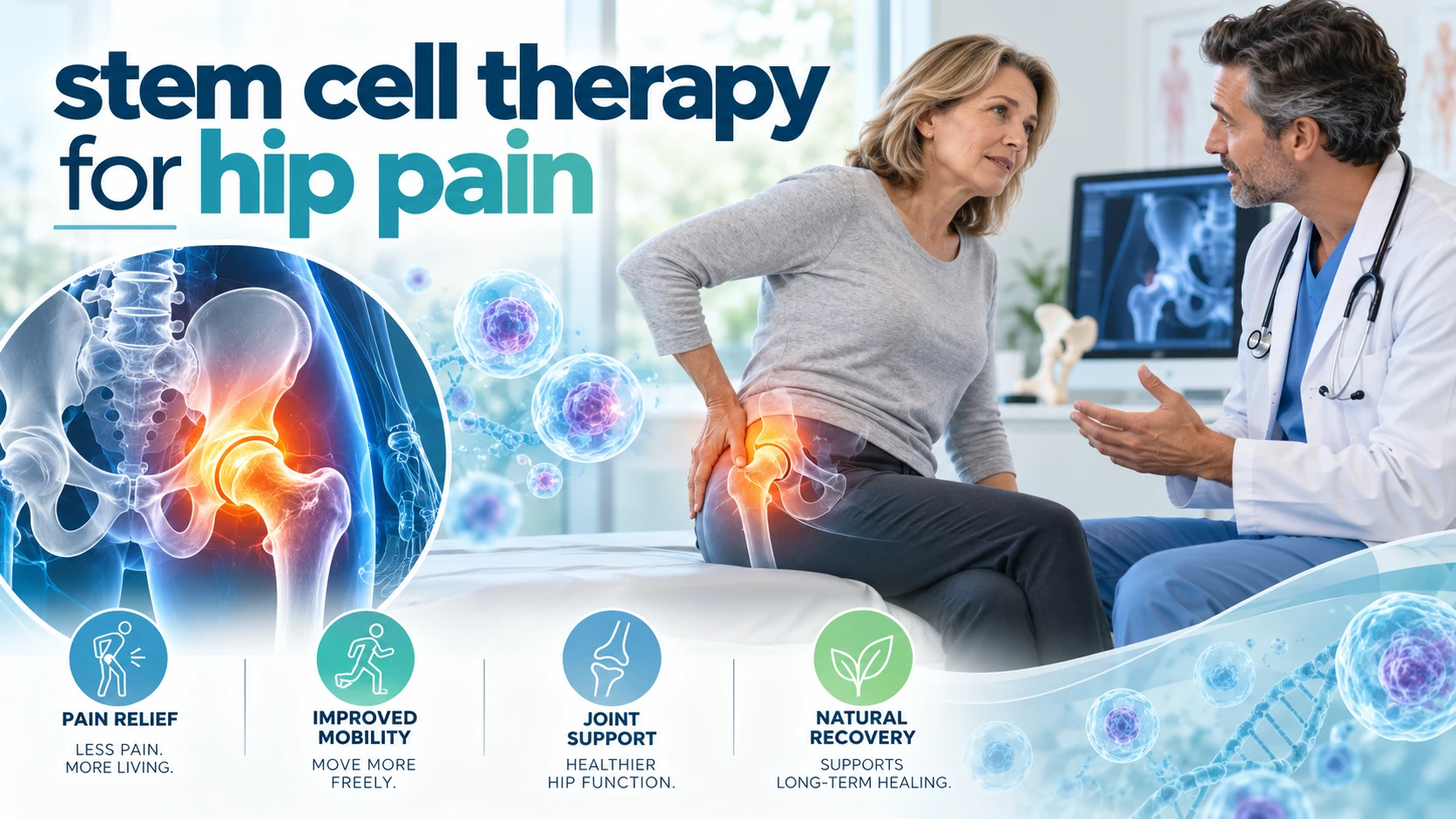
Stem cell therapy uses your body’s own cells to calm inflammation and support tissue repair in the hip, often for osteoarthritis, labral tears, bursitis, or early avascular necrosis.
Research shows real but modest pain relief, not a guaranteed fix.
Here’s what the evidence actually says, what it costs, how recovery works, and how Everest Regenerative Medicine approaches hip pain for patients around West Fargo, North Dakota.
Hip pain can turn simple things like getting out of a car or climbing a flight of stairs into a daily struggle.
If you’ve been researching ways to avoid surgery, you’ve probably come across stem cell therapy for hip pain as an option worth a closer look.
At Everest Regenerative Medicine in West Fargo, we talk with patients from across the Fargo-Moorhead area who want a clear, honest answer about whether this treatment is right for them.
This guide breaks down what stem cell therapy actually does, what the research shows, and what you can realistically expect.
SEE IF STEM CELL THERAPY IS RIGHT FOR YOU
What Is Stem Cell Therapy for Hip Pain?
Stem cell therapy for hip pain is a treatment that takes cells from your own bone marrow or fat tissue and injects them into the hip joint.
The goal is to calm inflammation and support your body’s natural repair process.
It’s most often used for hip arthritis, labral tears, bursitis, and early-stage avascular necrosis.
The cells used in this treatment are called mesenchymal stem cells.
They don’t work like a patch or a graft.
Instead, they release signals that reduce inflammation and may encourage nearby tissue to heal a bit faster.
This falls under the broader umbrella of regenerative medicine, which focuses on helping the body repair itself rather than masking pain with medication or replacing a joint outright.
What Hip Conditions Can Stem Cell Therapy Treat?
Stem cell therapy isn’t a single fix for a single problem.
Doctors use it for several different hip conditions, each with its own level of evidence behind it.
Hip Osteoarthritis
Osteoarthritis is the most common reason people look into stem cell therapy for hip pain.
It’s also incredibly common: an estimated 595 million people worldwide had osteoarthritis in 2020, about 7.6% of the global population.
In the hip specifically, a 2025 scoping review found average pain score reductions of 30% to 50% among patients treated with stem cells, along with improvements on function scales like the Harris Hip Score.
Managing hip osteoarthritis early, before it reaches an advanced stage, tends to open up more treatment options.
Labral Tears
A labral tear happens when the ring of cartilage that stabilizes your hip socket gets damaged, often from sports, repetitive motion, or structural issues in the joint.
Doctors sometimes offer injections of corticosteroids, platelet-rich plasma, or stem cells to calm the joint and support healing before considering surgery.
Stem cells don’t repair the tear itself, but they can reduce the inflammation that makes the injury so painful.
Avascular Necrosis
Avascular necrosis happens when blood flow to part of the hip bone is cut off, causing the bone tissue to die.
It affects more than 20,000 Americans every year, often in their 30s and 40s.
When it’s caught early, before the bone collapses, stem cell injections can support new blood vessel growth in the damaged area.
One surgical technique developed at Yale has shown it can reduce the need for hip replacement by nearly 10% in appropriate candidates.
Bursitis and Tendon Injuries
Hip bursitis and tendon injuries around the joint can cause the same kind of deep, nagging pain as arthritis.
These softer tissue problems often respond well to regenerative treatments because there’s more blood flow available to support healing.
If you’re dealing with ongoing joint pain that hasn’t improved with rest or physical therapy, it’s worth getting a proper evaluation before choosing a next step.
How Does Stem Cell Therapy for Hips Actually Work?
The procedure starts with collecting stem cells from your own bone marrow or fat tissue, usually from the hip bone or abdomen. A technician concentrates the sample in a centrifuge, and the doctor injects it directly into the hip joint using ultrasound or X-ray guidance. The whole process typically takes less than an hour.
Doctors can pull stem cells from two main sources: bone marrow or fat tissue.
The different types of stem cell therapy, and how each sample is processed, can affect both cost and outcome, which is worth understanding before your consultation.
Imaging guidance during the injection matters too, since it helps the doctor place the cells precisely where the damage is rather than somewhere in the general area of the joint.
What Does the Research Say About Stem Cell Therapy for Hip Pain?
That Cochrane review looked at 1,341 participants across trials comparing stem cells to placebo, steroid injections, hyaluronic acid, and other treatments.
The improvement was real, but small, and some larger trials were withdrawn before they finished reporting results.
Separately, the hip osteoarthritis scoping review found adverse events were rare and mild, mostly temporary joint discomfort or swelling, with no major complications reported.
The takeaway isn’t that stem cell therapy doesn’t work.
It’s that the science is still catching up to the marketing, and anyone considering treatment deserves a straight answer about where the evidence currently stands.
Am I a Good Candidate for Stem Cell Therapy?
Good candidates for stem cell therapy usually have early to moderate hip osteoarthritis, a labral tear without major structural damage, or avascular necrosis caught before the bone collapses.
You’re also a stronger candidate if you’ve already tried conservative treatments like physical therapy or anti-inflammatory medication without enough relief.
Every hip is different, which is why a proper evaluation matters more than a quick online quiz.
During a consultation, your provider reviews imaging, your health history, and how far your condition has progressed to figure out whether stem cell therapy makes sense for you, or whether a different approach would serve you better.
Hip pain is just one of the conditions we treat, alongside a range of other joint and soft tissue issues.
SEE IF STEM CELL THERAPY IS RIGHT FOR YOU
Stem Cell Therapy vs. Hip Replacement Surgery
Hip replacement surgery is still the most reliable fix for severe, end-stage joint damage.
But for people who aren’t there yet, or who want to delay surgery as long as possible, stem cell therapy offers a non-surgical option with far less downtime.
There’s no incision, no hospital stay, and most patients are back to light activity within a day or two.
The two aren’t always competing options.
Some patients use stem cell therapy to manage pain for years before eventually needing surgery, while others combine it with platelet-rich plasma to get more mileage out of conservative care.
Weighing PRP vs. stem cell therapy for your specific situation usually comes down to how advanced your condition is and what you’ve already tried.
What to Expect During Recovery
Most patients feel mild soreness at the injection site for the first 48 to 72 hours.
Doctors typically recommend avoiding anti-inflammatory medication like ibuprofen for about two weeks before and after the procedure, since it can interfere with the healing response the treatment is trying to trigger.
Pain relief doesn’t happen overnight.
Most patients notice improvement starting around the three to six week mark, with continued gains over the following months.
The timeline matters here: understanding how long it takes for stem cell therapy to work can keep you from judging the results too early.
Avoiding certain medications and high-impact activity in those first few weeks, part of what not to do after stem cell treatment, gives the cells the best chance to take hold.
Risks and Limitations to Know About
Stem cell therapy carries a low risk of complications since it uses your own cells, but it has real limitations.
It’s not FDA approved as a cure for hip arthritis or injury, results vary from person to person, and the benefits aren’t permanent.
Because the treatment uses your own tissue, the risk of infection or rejection is low.
The bigger limitation is uncertainty: researchers still don’t fully know how long results last for every condition, and findings on how long stem cell therapy results last suggest the relief can fade over time for some patients, which is why many people eventually need repeat treatment.
If a clinic promises guaranteed, permanent results, that’s a sign to ask more questions rather than sign up on the spot.
How Everest Regenerative Medicine Approaches Hip Pain
At Everest Regenerative Medicine, we start every hip pain consultation the same way: by listening.
Patients from West Fargo and across the Fargo-Moorhead area come to us after trying medication, physical therapy, or injections that didn’t give them lasting relief.
Before recommending anything, we review your imaging and history to understand what’s actually driving your pain.
Depending on what we find, treatment might include stem cell therapy, platelet-rich plasma, or peptide therapy for joint healing, sometimes combined for a more complete approach.
We don’t believe in a one-size-fits-all injection.
We believe in treating the specific problem in front of us, with realistic expectations about what regenerative medicine can and can’t do.
If hip pain has been slowing you down and you want a straight answer about whether stem cell therapy makes sense for you, Everest Regenerative Medicine in West Fargo is a good place to start that conversation.
FAQs: Stem Cell Therapy for Hip Pain
How long does it take for stem cell therapy to relieve hip pain?
Most patients start noticing pain relief around three to six weeks after treatment, with improvement continuing over the following months. Results build gradually rather than appearing right away, since the cells need time to reduce inflammation and support tissue repair.
How long do the results of stem cell therapy for hips last?
Results vary widely by patient and condition. Some people experience relief for a year or longer, while others need a repeat treatment sooner. Research on long-term durability is still limited, so it’s reasonable to expect you may need maintenance treatment over time.
Can stem cell therapy help me avoid a hip replacement?
It can help some patients delay or reduce their need for surgery, especially with early-stage osteoarthritis or avascular necrosis caught before bone collapse. It’s not a replacement for surgery in advanced cases, but it can be a useful step before reaching that point.
What’s the difference between PRP and stem cell therapy for hip pain?
PRP uses concentrated platelets from your own blood to trigger healing and reduce inflammation, while stem cell therapy uses cells from bone marrow or fat tissue that can influence tissue repair more broadly. PRP is generally less expensive and is often tried first, while stem cell therapy is considered for more significant joint damage.
Who is not a good candidate for stem cell therapy in the hip?
People with advanced, end-stage hip osteoarthritis, active infections, certain autoimmune conditions, or bone that has already collapsed from avascular necrosis typically aren’t good candidates. A hip replacement or other surgical option is usually a better fit at that stage.