
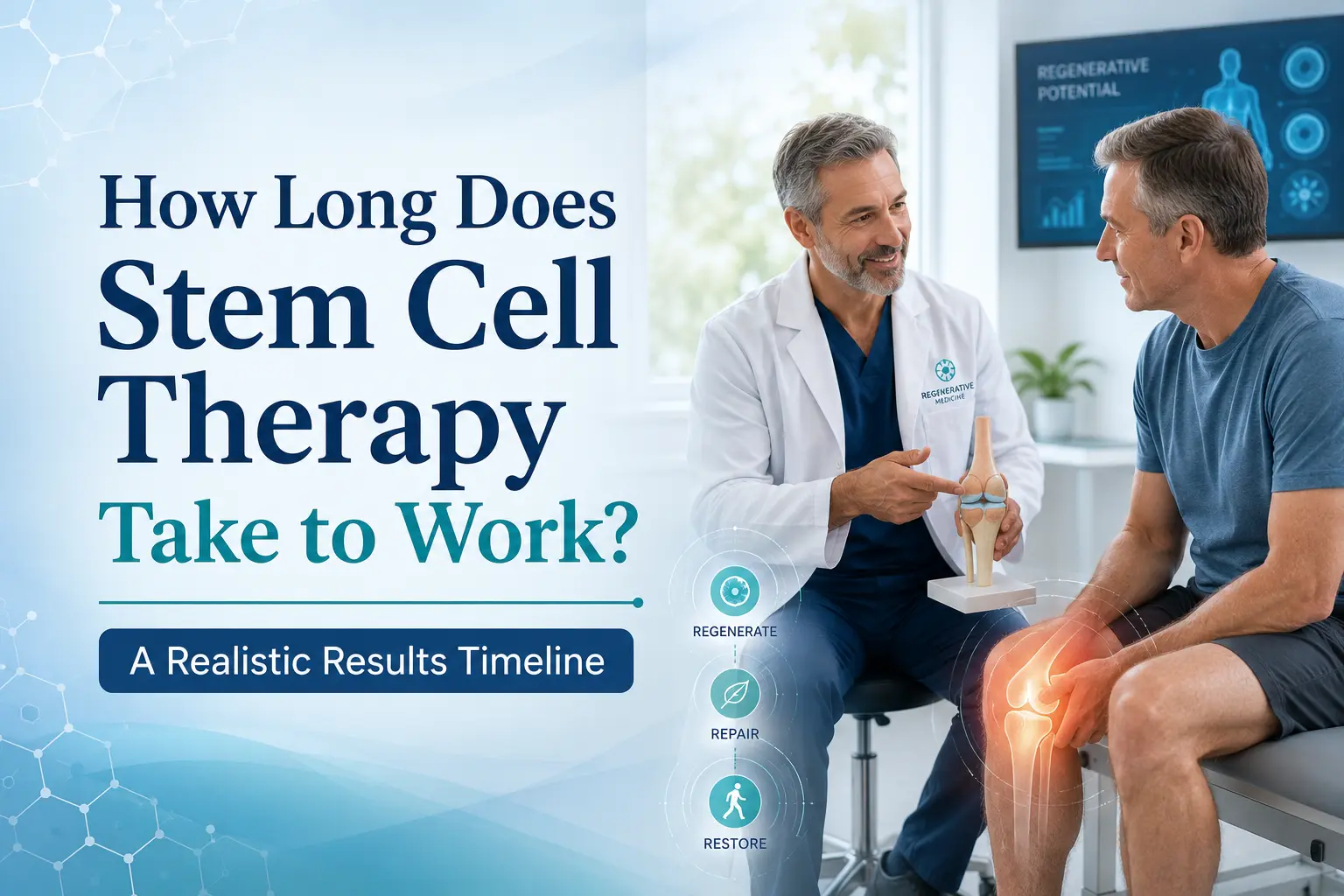
When you are dealing with ongoing joint pain or an injury that has not improved as expected, you may want to know how soon a regenerative treatment could make a difference.
So, how long does stem cell therapy take to work?
For orthopedic and musculoskeletal procedures, some people may begin noticing gradual changes in pain, stiffness, or movement within several weeks.
However, it often takes approximately three to six months to evaluate the response more clearly.
When improvements occur, they may continue developing for six months or longer.
There is no universal timeline.
The type of procedure, condition being treated, severity of tissue damage, overall health, and rehabilitation plan can all influence how quickly someone notices a change.
Results vary, and not everyone experiences a meaningful improvement.
This article focuses on cell-based procedures used for joints, tendons, ligaments, muscles, and other musculoskeletal concerns.
Blood-forming stem cell transplants used for cancer and certain blood disorders have a very different treatment and recovery process.
GET HELP WITH REGENERATIVE OPTIONS
Key Takeaways
- Some people notice early changes within three to six weeks.
- Three to six months is often a more useful window for evaluating results.
- The timeline depends on the condition, treatment type, health, and rehabilitation plan.
- Feeling less pain does not necessarily prove that damaged tissue has regrown.
- Results are not guaranteed, and some people may not experience meaningful improvement.
How Long Do Stem Cells Take to Work?
When people ask how long stem cells take to work, they are usually asking when they will feel less pain or move more comfortably.
Some people report small changes within a few weeks, but it may take several months to determine whether a procedure has provided a meaningful benefit.
Clinical studies of orthopedic cell-based treatments commonly evaluate pain and physical function at three, six, and twelve months.
The response is usually gradual rather than immediate.
During the first few weeks, symptoms may fluctuate, and it may be too early to judge the final outcome.
What Does “Stem Cell Therapy” Mean?
The term “stem cell therapy” can describe several very different procedures.
This is one reason there is no single recovery or results timeline that applies to everyone.
In orthopedic care, the term may be used for procedures involving bone marrow aspirate concentrate, commonly called BMAC, or other cell-containing products.
BMAC is not made up solely of isolated stem cells.
It contains a mixture of cells, platelets, growth factors, and other biological components.
The source of the product, how it is prepared, the number and type of cells present, and where it is placed can vary between procedures.
Orthopedic cell-based injections should also be distinguished from hematopoietic stem cell transplants.
These hospital-based treatments are used to rebuild blood and immune cells in people with certain serious illnesses.
Their timeline and purpose are completely different.
Before undergoing any procedure, ask what product will be used, where it comes from, how it is prepared, and what evidence supports its use for your condition.
When Do Stem Cell Injections Start Working?
Some people may begin noticing changes within three to six weeks, but it can take three to six months to assess the results more clearly.
An injection does not typically produce a predictable day when it suddenly “starts working.”
Early changes may be subtle, such as less stiffness, slightly better movement, or an ability to tolerate more activity.
Others may not notice a difference during the first several weeks.
That does not necessarily determine the final outcome, but ongoing symptoms should be reviewed during follow-up appointments.
Stem Cell Therapy Results Timeline
The following stem cell therapy results timeline is a general guide.
Individual recovery can vary based on the procedure, treatment area, and condition.
| Time after treatment | What you may experience |
| First few days | Temporary soreness, swelling, stiffness, or tenderness near the treatment area |
| Weeks 1–2 | Symptoms may fluctuate, and it is usually too early to evaluate the outcome |
| Weeks 3–6 | Some people may notice small changes in pain, movement, or activity tolerance |
| Months 2–3 | Improvements may become easier to recognize during daily activities |
| Months 3–6 | This is often a more useful period for evaluating pain and physical function |
| Months 6–12 | Follow-up may show whether any improvement has continued or remained stable |
The first few days
The first several days are generally part of the immediate recovery period rather than the results period.
Depending on the procedure, the area may feel sore, stiff, swollen, or temporarily more uncomfortable.
This reaction does not necessarily indicate whether the procedure will ultimately help.
Follow the activity restrictions and recovery instructions provided by your clinician.
These may include guidance about movement, pain relief, exercise, and returning to normal activities.
Weeks one through six
Symptoms may be inconsistent during the first month.
You could have a good day followed by a day when the area feels more irritated.
Some people notice early changes between three and six weeks.
These may include:
- Less discomfort during a particular movement
- Reduced stiffness after sitting
- Improved walking tolerance
- Fewer pain-related sleep interruptions
- Greater comfort during rehabilitation exercises
Others do not experience noticeable changes during this period.
Months two through three
By approximately two to three months, it may become easier to compare your current symptoms and function with how you felt before treatment.
Instead of asking whether the area feels completely normal, look for specific changes.
You may be able to climb stairs more comfortably, walk farther, complete a work shift with less pain, or tolerate exercise more easily.
Three months is also a common follow-up point in clinical research evaluating orthopedic treatments.
Months three through six
The three-to-six-month period often provides a clearer picture of the response.
Your clinician may evaluate:
- Pain during specific activities
- Range of motion
- Strength
- Joint stability
- Walking tolerance
- Ability to work or exercise
- Performance during everyday tasks
Progress should be compared with your own starting point, not another person’s results or a patient testimonial.
Months six through twelve
Some people continue to notice gradual changes beyond six months, while others reach a plateau earlier.
Longer-term follow-up can help determine whether improvement has been maintained and whether the procedure made a worthwhile difference in daily life.
It also gives your provider an opportunity to adjust rehabilitation or discuss other treatment options.
What Does It Mean for Stem Cell Therapy to Be Working?
“Working” can mean different things depending on the condition and the person’s goals.
For someone with knee pain, progress may mean being able to walk through a store with less discomfort.
Someone with a tendon injury may want to return to running, lifting, or playing a sport.
Another person may primarily want to sleep without being awakened by pain.
Possible signs that symptoms and function are improving include:
- Less pain during a specific activity
- Reduced morning stiffness
- Better range of motion
- Improved stability
- Increased walking or exercise tolerance
- Fewer sleep interruptions
- Greater ability to complete daily tasks
- Better scores on pain or function questionnaires
One unusually good or bad day does not provide enough information.
Look for a consistent pattern over several weeks.
It is also important to understand that symptom improvement does not automatically prove that cartilage, tendons, or other structures have regenerated.
Reduced pain and better function can occur without visible structural changes.
Why Can Results Take Several Months?
Orthopedic regenerative treatments are not fast-acting numbing treatments.
When a benefit occurs, it may develop through gradual biological and functional processes.
These may include changes in cellular signaling, inflammation, tissue remodeling, strength, movement patterns, and tolerance for rehabilitation.
Your muscles and movement habits may also need time to adapt.
When pain has been present for months or years, nearby muscles can become weak or overactive.
You may change the way you walk, bend, lift, or exercise without realizing it.
An injection alone does not automatically correct those patterns.
A structured rehabilitation plan may be needed to restore strength, flexibility, stability, and confidence.
What Affects How Quickly Stem Cell Therapy Works?
Let’s take a look at some of the factors that can affect how long stem cells take to work:
The condition being treated
A recent tendon injury may have a different timeline from long-standing osteoarthritis.
Cartilage, tendons, ligaments, muscles, bones, and nerves also respond differently.
An accurate diagnosis is important because pain near a joint does not always originate inside the joint.
The severity of tissue damage
The extent of structural damage may affect the likelihood and timing of improvement.
Someone with mild or moderate degeneration may have different expectations from someone with severe joint-space loss, significant instability, extensive cartilage damage, or a complete tendon tear.
Cell-based treatment cannot be assumed to reverse every form of damage.
The type of product and procedure
Not every procedure marketed under the stem cell label contains the same biological components.
Differences may include:
- Cell or tissue source
- Processing method
- Concentration
- Injection technique
- Treatment location
- Use of additional treatments
These differences make it difficult to apply one study or timeline to every patient.
Your overall health
General health can affect inflammation, circulation, tissue quality, recovery, and the ability to participate in rehabilitation.
Conditions such as diabetes, vascular disease, and immune disorders may also influence healing or procedural risk.
Smoking and nicotine use
Nicotine can affect circulation and tissue healing.
A provider may recommend reducing or stopping nicotine use before and after a procedure.
Tell your clinician about smoking, vaping, and other nicotine products so you can receive appropriate guidance.
Your rehabilitation plan
Doing too much too soon may irritate the treatment area.
Avoiding activity for too long can also contribute to weakness, stiffness, and reduced function.
The right balance depends on your condition.
Follow a gradual recovery plan rather than testing the area with strenuous exercise as soon as it begins to feel better.
Your expectations
Stem cell therapy is sometimes presented in ways that create unrealistic expectations.
It should not be viewed as a guaranteed way to regrow a joint, eliminate pain permanently, or prevent every future surgery.
Evidence for orthopedic cell-based treatment remains mixed, and outcomes vary between patients.
How Long Do Stem Cell Injections Take to Work for Different Conditions?
The expected timeline may differ based on the treatment area, diagnosis, and rehabilitation demands.
| Condition or treatment area | When early changes may be noticed | When results may be assessed more clearly |
| Knee osteoarthritis | Several weeks to three months | Approximately three to six months |
| Hip joint symptoms | Several weeks to several months | Approximately three to six months or longer |
| Shoulder conditions | Several weeks to three months | Approximately three to six months |
| Tendon or ligament injuries | Several weeks to several months | Depends heavily on healing and rehabilitation |
| Back or spine-related pain | Varies considerably by diagnosis | Often several months, if improvement occurs |
These ranges are not guaranteed treatment schedules.
Different diagnoses within the same body area can have very different outcomes.
Knee and hip joints
People receiving treatment for knee or hip symptoms may track:
- Walking distance
- Morning stiffness
- Ability to climb stairs
- Comfort while standing
- Ability to rise from a chair
- Exercise tolerance
Research is more developed for knee osteoarthritis than for many other orthopedic uses, but findings remain inconsistent.
Results involving the knee should not automatically be applied to the hip, shoulder, spine, or other areas.
Shoulder conditions
Shoulder recovery depends heavily on the diagnosis.
Arthritis, bursitis, tendon irritation, and rotator cuff tears are different problems.
Useful progress markers may include:
- Sleeping on the affected side
- Reaching overhead
- Getting dressed
- Lifting objects
- Range of motion
- Strength during daily activities
Tendon and ligament injuries
Tendons and ligaments are regularly exposed to force.
Even when pain begins to improve, the tissue and surrounding muscles may not be ready for unrestricted sports or heavy work.
A gradual strengthening plan may be needed before returning to running, jumping, throwing, or lifting.
Back and spine-related pain
Back pain can originate from discs, joints, muscles, nerves, or several structures at the same time.
Because the location of pain does not always reveal its source, a careful diagnosis is needed before considering a procedure.
Treatment should not be based on the general assumption that a regenerative injection will repair a damaged disc.
Why Might Stem Cell Therapy Not Work?
Some people do not experience a meaningful improvement after a cell-based procedure.
Possible reasons include:
- The pain is coming from a different structure
- The original diagnosis was incomplete
- The tissue damage is too advanced
- Nerve irritation is contributing to the symptoms
- The condition requires surgical repair
- Activity was increased too quickly
- Significant weakness or movement problems remain
- The rehabilitation plan needs to be adjusted
- The procedure did not provide a meaningful response
More injections are not automatically the answer.
When improvement does not occur, the provider should review the diagnosis, progress, recovery plan, and available alternatives.
How Should You Track Your Progress?
Before treatment, identify several activities that are limited by your symptoms.
Examples include:
- Walking for 20 minutes
- Climbing one flight of stairs
- Getting out of a chair
- Sleeping through the night
- Reaching overhead
- Completing a work shift
- Exercising without a major pain flare
Record your ability to perform these activities once each week.
Checking several times per day can make normal fluctuations seem more significant than they are.
Other useful measures may include step counts, activity logs, range-of-motion measurements, and standardized pain or function questionnaires.
Imaging may sometimes be appropriate, but changes on an MRI do not always match changes in pain or mobility.
What Should You Expect During Recovery?
A stem cell therapy recovery timeline depends on the procedure and body area.
Most people should expect some period of activity modification.
Your plan may involve:
- Temporarily limiting strenuous exercise
- Gradually returning to normal movement
- Beginning or continuing rehabilitation
- Avoiding activities that place excessive stress on the area
- Attending scheduled follow-up appointments
- Tracking symptoms and function over time
Do not assume that increasing pain is a necessary sign that treatment is working.
Severe or worsening symptoms should be discussed with your provider.
How Long Do Stem Cell Therapy Results Last?
The time it takes to notice a result is different from how long that result may last.
When improvement occurs, its duration can vary.
The underlying condition may continue to progress, and the treated area can still be affected by age, activity, movement patterns, new injuries, and general health.
Some studies follow patients for one or two years, but this does not mean every person will experience improvement for that amount of time.
Be cautious with promises that one procedure will provide a specific number of months or years of relief.
When Should You Contact Your Provider?
Some temporary soreness may occur after an injection, but you should know which symptoms require medical attention.
Contact your provider promptly if you experience:
- Increasing redness or warmth
- Drainage from the treatment area
- Fever or chills
- Severe or rapidly worsening pain
- Significant swelling
- New numbness or weakness
- Difficulty breathing
- Signs of an allergic reaction
- Symptoms that differ from the recovery plan you were given
Follow-up care gives your provider an opportunity to evaluate your recovery, answer questions, and adjust activity or rehabilitation recommendations.
Discuss Regenerative Medicine Options With Everest
The right question is not only, “How long does stem cell therapy take to work?”
It is also, “Is this type of treatment appropriate for the cause and severity of my condition?”
A personalized evaluation with Everest Regenerative Medicine can help identify the source of your symptoms, review previous treatments, and determine which regenerative treatment or rehabilitative options may be reasonable.
Our clinic evaluates concerns such as joint pain, osteoarthritis, inflammation, sports injuries, and tendon or ligament problems.
Your care plan should be based on your diagnosis, goals, health history, and the available evidence, not a guaranteed timeline.
Contact us to learn more about your options today.
FAQs: How Long Does Stem Cell Therapy Take to Work
How long do stem cells take to work?
Some people may notice changes within three to six weeks, but a more meaningful evaluation often takes three to six months. The timeline depends on the treatment, condition, severity, health factors, and rehabilitation plan. Some people may not experience a significant improvement.
How long after stem cell injections do you feel better?
Some people report feeling better within a few weeks, while others need several months before noticing a consistent difference. Early changes may include less stiffness, improved movement, or greater activity tolerance. Results vary, and improvement is not guaranteed.
Can stem cell therapy work immediately?
Stem cell therapy is not generally expected to provide an immediate final result. Any early relief may be influenced by temporary factors related to the procedure. More meaningful changes in pain and function should be evaluated over several weeks or months.
What are the signs stem cell therapy is working?
Possible signs include less pain during certain activities, reduced stiffness, better range of motion, improved sleep, and increased walking or exercise tolerance. Look for a consistent trend over several weeks rather than judging the result from one day.
How long should you rest after stem cell therapy?
The appropriate rest period depends on the procedure and treatment area. A recovery plan may include a brief period of activity modification followed by a gradual return to movement. Follow the instructions provided by your clinician.
Does physical therapy help after stem cell therapy?
Physical therapy or structured rehabilitation may help improve strength, mobility, balance, and movement patterns. It cannot guarantee that the procedure will work, but it may support function and overall recovery.
Can stem cells help with back pain?
Cell-based treatments may help reduce pain and improve function in some carefully selected people with disc-related lower back pain, but research remains limited and results vary. Because back pain may originate from discs, joints, nerves, muscles, or other structures, an accurate diagnosis is needed before considering treatment. Stem cell therapy should not be viewed as a guaranteed way to regenerate a damaged disc or eliminate back pain.