
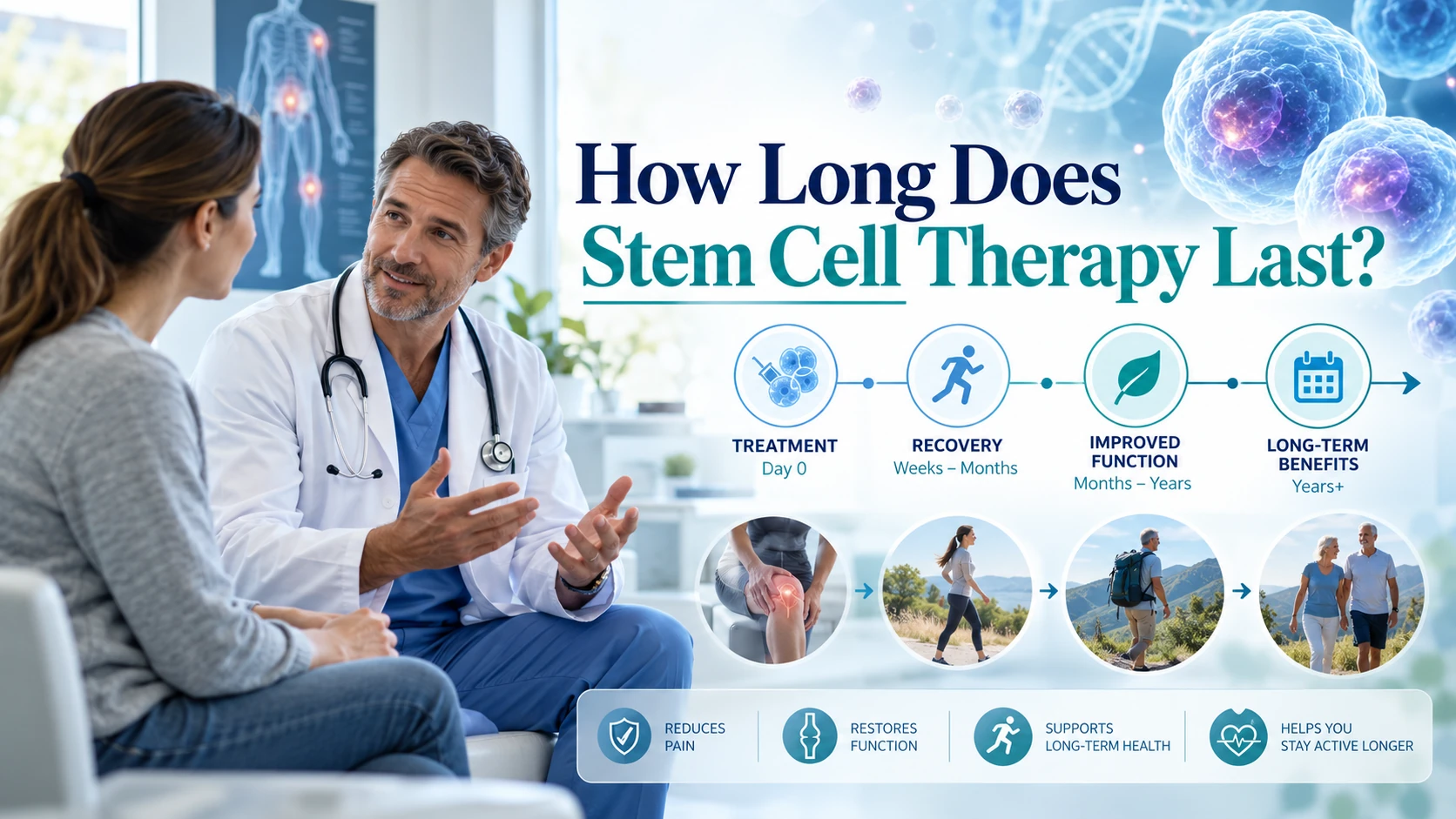
Most patients feel initial relief from stem cell therapy within 4 to 12 weeks.
For joint conditions like knee osteoarthritis, benefits typically last 1 to 5 years, depending on severity, age, and aftercare.
Long-term research shows results gradually fade around year 5 to 7, though many patients extend relief with booster treatments every 18 to 24 months.
A personalized plan makes the biggest difference in how long your results hold.
If you’re weighing stem cell therapy for a stubborn joint, tendon, or back problem, the question that matters most isn’t whether it works.
It’s how long does stem cell therapy last once it does.
The honest answer is that it depends on your condition, your age, and how your body responds.
Real research gives a clearer picture than the vague “it varies” answer you’ll find on most clinic websites.
This guide walks through what the data actually shows, broken down by condition, so you have an idea of what to expect before you commit to treatment.
SEE IF STEM CELL THERAPY IS RIGHT FOR YOU
How Long Does Stem Cell Therapy Last?
Stem cell therapy typically lasts between 1 and 5 years for most orthopedic conditions, with knee osteoarthritis patients often reporting meaningful relief for 2 to 5 years.
Results tend to peak around 6 to 18 months after treatment, then gradually decline, though many patients maintain benefits longer with proper aftercare and periodic booster treatments.
That range is wide because stem cell therapy isn’t one single treatment.
A knee injection for osteoarthritis behaves differently than a shoulder injection for a partial rotator cuff tear, and a younger patient with mild joint wear holds onto results far longer than someone with advanced, bone-on-bone arthritis.
Instead of chasing one universal number, it helps to look at what actually happens inside the joint over time, and what the research shows for your specific situation.
That’s what the rest of this guide breaks down.
How Soon Will You Feel It Working?
Most patients notice early improvement within 4 to 12 weeks, as the injected cells calm inflammation and begin signaling the body’s own repair process.
Full benefits usually build gradually over 3 to 6 months, which is different from how long those benefits last once they arrive.
This distinction trips a lot of people up.
The timeline for stem cell therapy to start working is a separate question from how long it lasts once it kicks in.
Mesenchymal stem cells, the type most commonly used for joint and tissue conditions, don’t typically turn into brand new cartilage on day one.
Instead, they release proteins and signaling molecules that calm inflammation and recruit the body’s own repair cells to the area.
That slower, biological process is also why results don’t show up overnight, and why there are several different types of stem cell therapy suited to different conditions and timelines.
How Long Do Results Last by Condition?
Duration varies more by body part and condition than almost any other factor.
Here’s what the evidence shows for the most common uses.
Knee Osteoarthritis
Knee osteoarthritis has the most research behind it, and the results are encouraging.
In a large prospective study that followed 297 patients for 24 months, 87.9% of patients reported improvement, with pain scores dropping 46.5% at 12 months and 54.5% at 24 months.
Longer-term data tells a more nuanced story.
A seven-year study tracking knee osteoarthritis patients found that clinical improvement scores remained significantly better than baseline through the 60-month mark, then declined noticeably by the 84-month (7-year) point. Interestingly, cartilage structure on MRI stayed measurably better than baseline even after symptom relief faded, suggesting the treatment’s physical effects can outlast the pain relief you actually feel.
If you’re exploring treatment for this condition specifically, our page on stem cell therapy for osteoarthritis covers candidacy and what to expect in more detail, and we’ve also broken down how well stem cell therapy works for knees specifically.
Shoulder and Rotator Cuff Injuries
Tendon and soft tissue injuries, like partial rotator cuff tears, tend to respond on a somewhat shorter and more variable timeline than cartilage-based joint conditions.
Tendons have less blood supply than bone or synovial tissue, which can mean a longer path to full healing and more dependence on a proper rehab program after treatment.
Our guide to stem cell treatment for rotator cuff tears walks through what realistic recovery looks like for this specific injury.
Back and Spine Conditions
Spine-related treatment, such as for disc degeneration or facet joint pain, generally requires closer monitoring because the structures involved are more complex and the condition is often progressive.
Many patients see meaningful relief, but durability depends heavily on the underlying cause of the pain and how far the degeneration has progressed.
We cover this in depth on our stem cell therapy for back pain page.
What Does the Research Really Show About Durability?
It’s worth being direct about what the science says, including the parts that don’t make for the flashiest marketing.
The seven-year knee osteoarthritis study mentioned above used a single dose of a defined cell concentration and found meaningful clinical benefit lasting around 60 months, with a noticeable decline by year seven.
That’s a genuinely strong result for a single treatment, but it also means “lasts forever” claims don’t hold up against the data.
A separate systematic review looked at something most patients never hear about: how much of the reported pain relief from stem cell injections comes from the treatment itself, versus contextual effects like the attention of a provider, the expectation of improvement, or the natural ebb and flow of arthritis pain.
That review found contextual factors accounted for roughly half to two-thirds of the reported improvement at both 6 and 12 months, though the certainty of that evidence was rated low due to small trial sizes.
This doesn’t mean stem cell therapy doesn’t work.
It means the research is still maturing, individual results vary more than a single average suggests, and a provider who’s upfront about that variability is more trustworthy than one who promises a fixed number of years.
What Factors Determine How Long Your Results Last?
How long your results last depends mainly on four things: your age, how advanced your condition was before treatment, how well you follow post-treatment care, and the type and dose of cells used.
Younger patients with mild to moderate joint damage who follow physical therapy protocols tend to hold their results the longest.
Age and overall health.
Stem and progenitor cells naturally lose some regenerative capacity as the body ages, which is documented in research on aging and chronic disease.
A younger, healthier patient’s own cells generally have more repair potential than an older patient’s, which can translate into longer-lasting results.
How advanced the condition is.
Mild to moderate osteoarthritis responds better than severe, bone-on-bone arthritis.
Early intervention, before a joint has broken down completely, tends to produce results that last longer and respond better to future booster treatments.
Adherence to aftercare.
Physical therapy, activity modification, and attending follow-up visits all support the repair process.
Skipping rehab or returning to high-impact activity too soon can shorten how long results hold.
Cell type and dose.
The concentration and source of cells used (often your own bone marrow or fat tissue, known as autologous cells) affects outcomes.
The seven-year study referenced above used a specific, defined dose, and outcomes can differ with a different cell count or source.
Do You Need Booster Treatments?
Not every patient needs a repeat treatment, but many people with chronic or progressive conditions like osteoarthritis benefit from a booster every 18 to 24 months to maintain results and delay further joint degeneration.
Your provider can tell you whether periodic maintenance makes sense based on how your first treatment responded.
A phase I study on repeated intra-articular injections for knee osteoarthritis found that repeat dosing was well tolerated and supported sustained benefit over the study period, supporting the idea that a maintenance schedule can be a reasonable long-term strategy rather than a one-and-done gamble.
Some patients also combine stem cell therapy with other regenerative options between booster sessions.
Understanding how PRP compares to stem cell therapy can help you and your provider decide whether alternating or combining treatments fits your maintenance plan.
How to Make Your Results Last Longer
You have more control over your results than you might think.
A few habits consistently show up in patients who hold onto their improvement the longest.
- Follow activity restrictions closely in the first few weeks after treatment, since overloading the area too soon can interrupt the repair process
- Complete any physical therapy or rehab program your provider recommends, even after the pain improves
- Maintain a healthy weight, since extra load on a joint accelerates wear and shortens how long relief lasts
- Avoid smoking and limit alcohol, both of which slow tissue repair
- Keep follow-up appointments so your provider can catch early signs of decline and recommend a booster before symptoms return in full
Our breakdown of what to avoid in the weeks after stem cell treatment goes into more specific dos and don’ts for the early recovery window.
Is Stem Cell Therapy Safe and Regulated?
Legitimate stem cell therapy using your own (autologous) cells for orthopedic conditions is generally safe when performed by a qualified provider, but the FDA has warned about clinics marketing unapproved stem cell and exosome products with unsubstantiated claims.
Choosing a provider who is transparent about what the evidence does and doesn’t show is one of the most important safety steps you can take.
The FDA has issued a public safety alert after receiving reports of serious adverse events, including infections, tumor formation, and vision loss, linked to unapproved regenerative products marketed with exaggerated claims.
The only stem cell products currently FDA-approved are certain blood-forming stem cells derived from umbilical cord blood, which means most orthopedic stem cell treatments fall under a provider’s clinical judgment rather than a specific FDA approval for that use.
Before starting treatment, it’s reasonable to ask where your provider sources cells from, how they’re processed, and what specific outcomes they’ve seen in patients with your condition.
A provider who answers plainly, without guaranteeing a fixed number of years, is generally a good sign.
How Everest Regenerative Medicine Builds a Long-Lasting Treatment Plan
Every patient who comes through our doors at Everest Regenerative Medicine in West Fargo has the same underlying question: will this work, and for how long?
We start every consultation by being straightforward about what the evidence supports for your specific condition, rather than promising a one-size-fits-all timeline.
Our regenerative medicine program combines stem cell therapy with complementary options like PRP, so your plan can be adjusted over time instead of locked into a single approach.
For patients managing a progressive condition like osteoarthritis, we build in a maintenance schedule from the start, rather than leaving you to figure out a booster on your own months later.
We also offer stem cell banking for patients who want to preserve their own cells now, while they’re younger and healthier, for use in future regenerative treatments.
Patients across the Fargo-Moorhead area and the broader North Dakota, Minnesota, and South Dakota region come to our West Fargo clinic for this kind of personalized planning, including those exploring osteoarthritis treatment in West Fargo.
If you want a realistic answer about how long stem cell therapy would last for your specific joint or injury, a consultation is the most reliable way to get one.
FAQs: How Long Does Stem Cell Therapy Last
How long does stem cell therapy last for knee pain?
Most patients with knee osteoarthritis report meaningful relief for 2 to 5 years, with some studies showing measurable clinical improvement persisting through the 5-year mark and structural cartilage benefits lasting even longer.
How many stem cell treatments do you need?
Many patients see lasting benefit from a single treatment, while others with chronic or progressive conditions choose a booster every 18 to 24 months to maintain results. The right number depends on your condition and how you responded to your first treatment.
Does stem cell therapy wear off completely?
For most patients, benefits fade gradually rather than disappearing all at once. Research on knee osteoarthritis shows clinical scores declining over several years, while some structural improvements in the joint can persist even after symptom relief diminishes.
Is stem cell therapy a permanent cure?
No. Stem cell therapy is best understood as a way to reduce inflammation and support the body’s own repair process, not a permanent fix. It won’t regrow cartilage that’s already been lost, and chronic, progressive conditions like osteoarthritis typically require ongoing management.
How long after stem cell therapy until you see full results?
Most patients notice initial improvement within 4 to 12 weeks, with full benefits typically building over 3 to 6 months as the body’s repair process continues.