
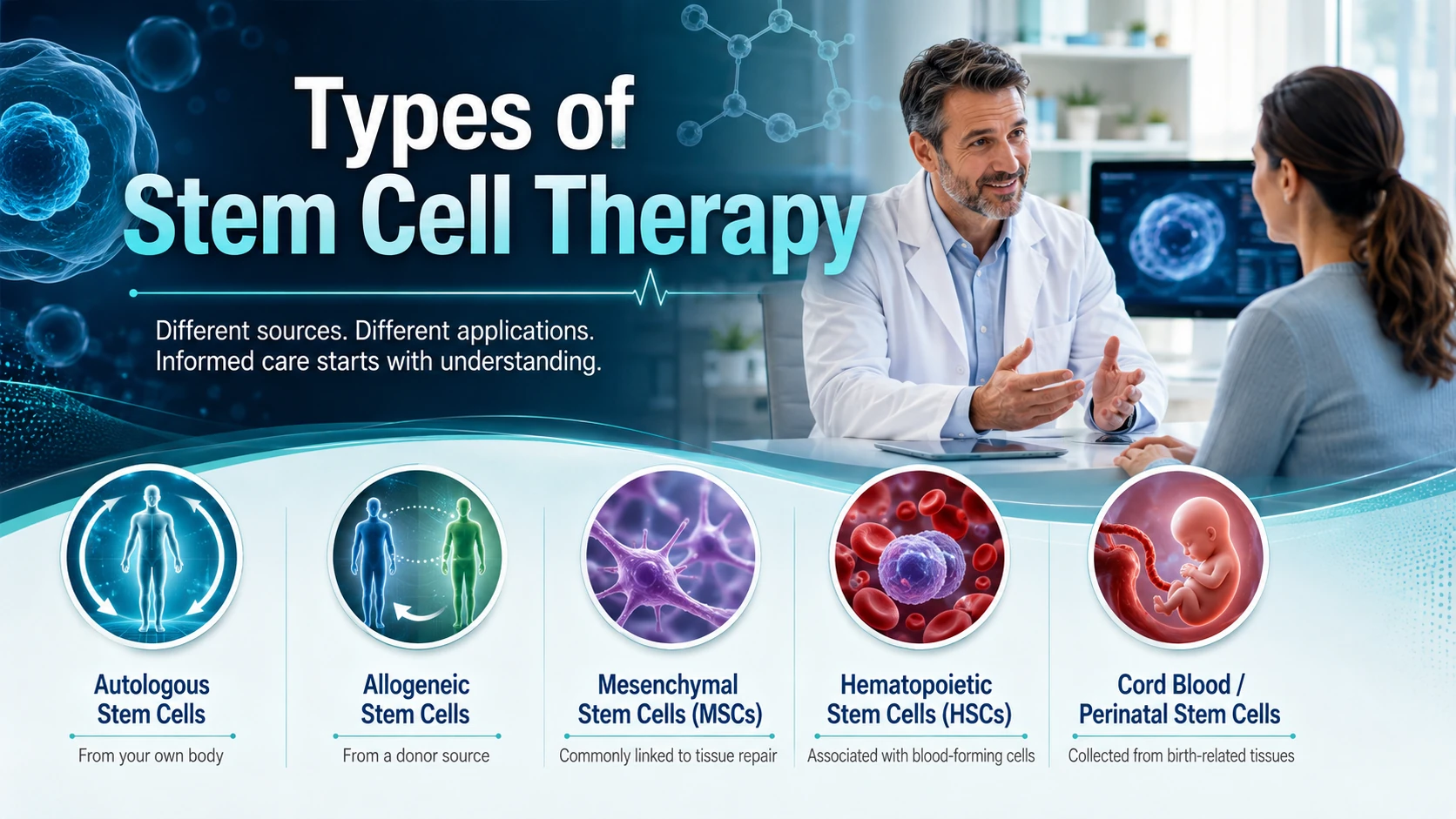
Stem cell therapy isn’t one treatment.
It’s a broad category that includes decades-old bone marrow transplants for blood cancers and newer regenerative medicine options like adipose-derived stem cells for joint pain.
The right type depends on your condition, where the cells come from, and whether the treatment is FDA-approved or still investigational.
This guide breaks down each type so you know exactly what you’re being offered.
When most people hear the phrase stem cell therapy, they picture one single treatment.
In reality, it’s an umbrella term for dozens of different procedures.
They use different cells, come from different sources, and treat completely different conditions.
A bone marrow transplant for leukemia and a knee injection for joint pain are both technically stem cell therapy.
Beyond that, they have almost nothing in common.
That gap in understanding is where a lot of confusion comes from, and where some clinics take advantage of patients.
Knowing the actual types of stem cell therapy, what they’re made of, and which ones have solid evidence behind them helps you ask better questions before committing to any treatment.
SEE IF STEM CELL THERAPY IS RIGHT FOR YOU
What Is Stem Cell Therapy?
Stem cell therapy is a medical treatment that uses stem cells, cells that can develop into other cell types or help repair damaged tissue, to treat disease or injury.
Depending on the type, it can rebuild a patient’s blood-forming system, calm inflammation in a joint, or support tissue repair after an injury.
Stem cells are different from most cells in your body.
A skin cell can only make more skin cells.
A stem cell can divide and turn into several different specialized cell types, or in some cases, almost any cell type at all.
That flexibility is what makes them useful in medicine.
Doctors can introduce stem cells into an area of damage or disease, and depending on the type of cell, they may replace damaged tissue, reduce inflammation, or release signals that encourage the body’s own repair process.
Not every stem cell treatment works the same way, though.
The type of cell, where it comes from, and how it’s delivered all change what the therapy can realistically do for you.
SEE HOW STEM CELLS CAN HELP YOU
What Are the Different Types of Stem Cells?
Stem cells fall into four broad categories: embryonic stem cells, adult stem cells, induced pluripotent stem cells, and perinatal stem cells from cord blood or tissue.
Each one has a different origin and a different range of cell types it can become.
Embryonic Stem Cells
Embryonic stem cells come from early-stage embryos and are considered pluripotent, meaning they can develop into almost any cell type in the body.
That versatility makes them valuable for research, but they come with significant ethical and regulatory restrictions.
Because of those restrictions, embryonic stem cells are rarely used in routine patient treatment today.
Most of their current value is in helping researchers understand disease and test new therapies.
Adult (Somatic) Stem Cells
Adult stem cells, sometimes called somatic stem cells, live in tissues throughout the body, including bone marrow, fat, and blood.
They’re more limited than embryonic stem cells in what they can become, but they’re the type used in nearly every stem cell treatment available today, including the options offered at regenerative medicine clinics.
Because adult stem cells can often be collected from the same person receiving treatment, they carry a lower risk of rejection than cells from another source.
Induced Pluripotent Stem Cells (iPSCs)
Induced pluripotent stem cells start as ordinary adult cells, often taken from skin or blood, that scientists reprogram in a lab to behave like embryonic stem cells.
A comprehensive review of cell-based therapies found that induced pluripotent stem cells are used mainly in research and drug testing rather than direct patient treatment, since long-term human safety data is still limited.
They’re a promising area for future therapies, but they aren’t something you’ll typically encounter in a clinic today.
Perinatal Stem Cells (Cord Blood and Tissue)
Perinatal stem cells are collected from umbilical cord blood or cord tissue after a baby is born.
Cord blood is the source behind most of the stem cell products approved for clinical use in the United States, which today are limited to treatments for blood and immune system disorders.
Cord tissue stem cells are handled differently and are more often used in research or investigational treatments rather than approved therapies.
Autologous vs. Allogeneic: Whose Cells Are Being Used?
Autologous stem cell therapy uses a patient’s own cells, while allogeneic therapy uses cells from a donor.
Autologous treatments carry a lower risk of rejection, while allogeneic treatments allow for banked, ready-to-use cells but require careful donor matching.
This distinction matters more than the source tissue in a lot of cases.
With autologous therapy, cells are collected from you, processed, and returned to you, so your immune system doesn’t treat them as foreign.
Allogeneic therapy uses cells from a donor instead.
Donor cells must be closely matched to the patient’s tissue type to reduce the risk of graft versus host disease, a serious complication where donor cells attack the recipient’s body.
A third, less common category is syngeneic therapy, which uses cells from an identical twin.
Because the genetic match is exact, it avoids rejection risk almost entirely, though it’s only an option for the small number of patients who have an identical twin willing to donate.
Where Do Regenerative Clinics Get Adult Stem Cells?
Most regenerative medicine clinics work with adult stem cells, and the source they use affects how the cells are collected and what they’re used for.
Bone Marrow-Derived Stem Cells
Bone marrow has been the most established source of adult stem cells for decades, going back to the earliest transplants for blood cancers.
It contains hematopoietic stem cells, which form blood and immune cells, along with a smaller number of mesenchymal stem cells, which support tissue repair.
Collecting bone marrow stem cells involves a needle aspiration from the hip bone, which can be uncomfortable and typically requires local or general anesthesia.
Adipose-Derived (Fat) Stem Cells
Fat tissue contains a much higher concentration of mesenchymal stem cells than bone marrow does, and it can be collected through a minimally invasive liposuction procedure.
That combination has made adipose-derived stem cells one of the more common sources at regenerative clinics, including here at Everest Regenerative Medicine.
Recent safety research backs this approach.
A long-term follow-up study on adipose-derived stem cell injections for rotator cuff tears found no evidence of adverse effects three years after treatment.
Patients who want to preserve their own cells for future use can also look into stem cell banking, which stores cells collected today for potential use down the road.
Umbilical Cord Tissue Stem Cells
Cord tissue stem cells come from the Wharton’s jelly inside the umbilical cord rather than the blood within it.
Some clinics use donor-derived cord tissue cells because they’re considered immune-privileged, meaning they’re less likely to trigger a strong immune reaction even though they come from someone else.
These treatments fall mostly into the investigational category, so it’s worth asking a provider directly about the evidence behind any cord tissue product before moving forward.
SEE WHICH OPTION IS RIGHT FOR YOU
What Conditions Is Stem Cell Therapy Used to Treat?
Stem cell therapy is used across three broad categories: established treatments for blood and immune disorders, orthopedic and joint applications supported by a growing body of research, and investigational uses for conditions like heart disease or neurological disorders that are still being studied.
Hematologic and Cancer Treatment
The best-established use of stem cell therapy is treating blood cancers and disorders like leukemia, lymphoma, and sickle cell disease.
These treatments typically use hematopoietic stem cells from bone marrow, peripheral blood, or cord blood to rebuild a patient’s blood-forming system after high-dose chemotherapy or radiation.
Orthopedic and Joint Conditions
Stem cell therapy is increasingly used for joint and musculoskeletal conditions, including knee osteoarthritis, tendon injuries, and chronic back pain.
A recent systematic review and meta-analysis of mesenchymal stem cells for knee osteoarthritis found measurable improvements in pain and function for some patients, though results varied depending on the specific study and cell source.
If you’re weighing this option for knee pain specifically, it helps to look at how your particular condition and severity align with what the research actually supports, rather than general marketing claims.
Investigational Applications
Researchers are also studying stem cells for heart disease, Parkinson’s disease, macular degeneration, and type 1 diabetes.
These applications show promise in early research, but none of them are currently approved treatments, and they’re typically only available through registered clinical trials.
How Does Stem Cell Therapy Compare to PRP and Exosome Therapy?
Stem cell therapy often gets grouped together with platelet-rich plasma (PRP) and exosome therapy, but they’re not the same thing.
PRP concentrates the platelets and growth factors already in a patient’s own blood, without introducing any additional stem cells.
Exosomes are tiny particles released by cells that carry signaling molecules to encourage tissue repair, but they don’t contain living cells at all.
If you’re trying to decide between these options, our detailed comparison of PRP and stem cell therapy walks through how each one works and which conditions they’re typically used for.
How Everest Regenerative Medicine Approaches Stem Cell Therapy
At Everest Regenerative Medicine, we focus on adipose-derived stem cells because fat tissue offers a rich, minimally invasive source of mesenchymal stem cells.
Our regenerative medicine program combines this approach with PRP and exosome therapy, depending on what your evaluation shows.
We also offer stem cell banking for patients who want to preserve younger, healthier cells now for potential use later, since cell quality tends to decline with age.
Every patient who comes through our West Fargo clinic starts with a real evaluation, not a one-size-fits-all recommendation.
We review your imaging, your symptoms, and your goals, and we’re direct about what the current research does and doesn’t support for conditions like osteoarthritis.
If a treatment isn’t likely to help you, we’ll tell you that too.
How Do You Know Which Type of Stem Cell Therapy Is Right for You?
The right type of stem cell therapy depends on your specific condition, health history, and how much evidence supports that use.
A consultation that reviews your imaging, symptoms, and goals is the most reliable way to find an appropriate option, rather than choosing based on a treatment’s popularity.
Start by asking what type of cell is being used, where it comes from, and whether that specific application is FDA-approved, investigational, or unproven for your condition.
A provider who can answer those questions clearly is a good sign.
It also helps to understand realistic timelines before you start.
Our guide on how long stem cell therapy takes to work covers what to expect week by week, and our post on what to avoid after treatment explains the habits that can affect your results during recovery.
Stem cell therapy isn’t a single treatment, and it isn’t a guarantee.
It’s a category of options that range from decades-proven to still investigational, and the right one depends entirely on your situation.
If you’re in the Fargo-Moorhead area and want to talk through which type of stem cell therapy actually fits your condition, the team at Everest Regenerative Medicine can walk you through your options and give you a straight answer.
FAQs: Types of Stem Cell Therapy
What is the most common type of stem cell therapy?
Hematopoietic stem cell transplants, often called bone marrow transplants, are the most established and widely used type of stem cell therapy. They’re used to treat blood cancers and other blood disorders and have been performed for decades.
Is stem cell therapy the same as a bone marrow transplant?
A bone marrow transplant is one specific type of stem cell therapy that uses hematopoietic stem cells, typically to treat blood cancers or immune disorders. Stem cell therapy also includes other treatments, like adipose-derived injections for joint pain, that work very differently.
What’s the difference between autologous and allogeneic stem cells?
Autologous stem cells come from the patient’s own body, while allogeneic stem cells come from a donor. Autologous treatments have a lower risk of rejection, while allogeneic treatments require careful donor matching to avoid complications.
Are adipose-derived stem cells better than bone marrow stem cells?
Neither source has been proven better for every condition. Fat tissue generally contains a higher concentration of mesenchymal stem cells and is easier to collect, while bone marrow has a longer track record in certain blood-related treatments.
Is stem cell therapy FDA-approved for joint pain?
No. The stem cell products currently approved by the FDA are limited to hematopoietic products for blood and immune disorders. Stem cell treatments for joint pain, including adipose-derived options, are offered under different regulatory pathways rather than as approved drugs.
How do I know if a stem cell clinic is legitimate?
Ask directly what type of cells are used, where they come from, and whether that specific treatment is FDA-approved, investigational, or unproven for your condition. Be cautious of any clinic that markets a single treatment as effective for a wide range of unrelated diseases.