
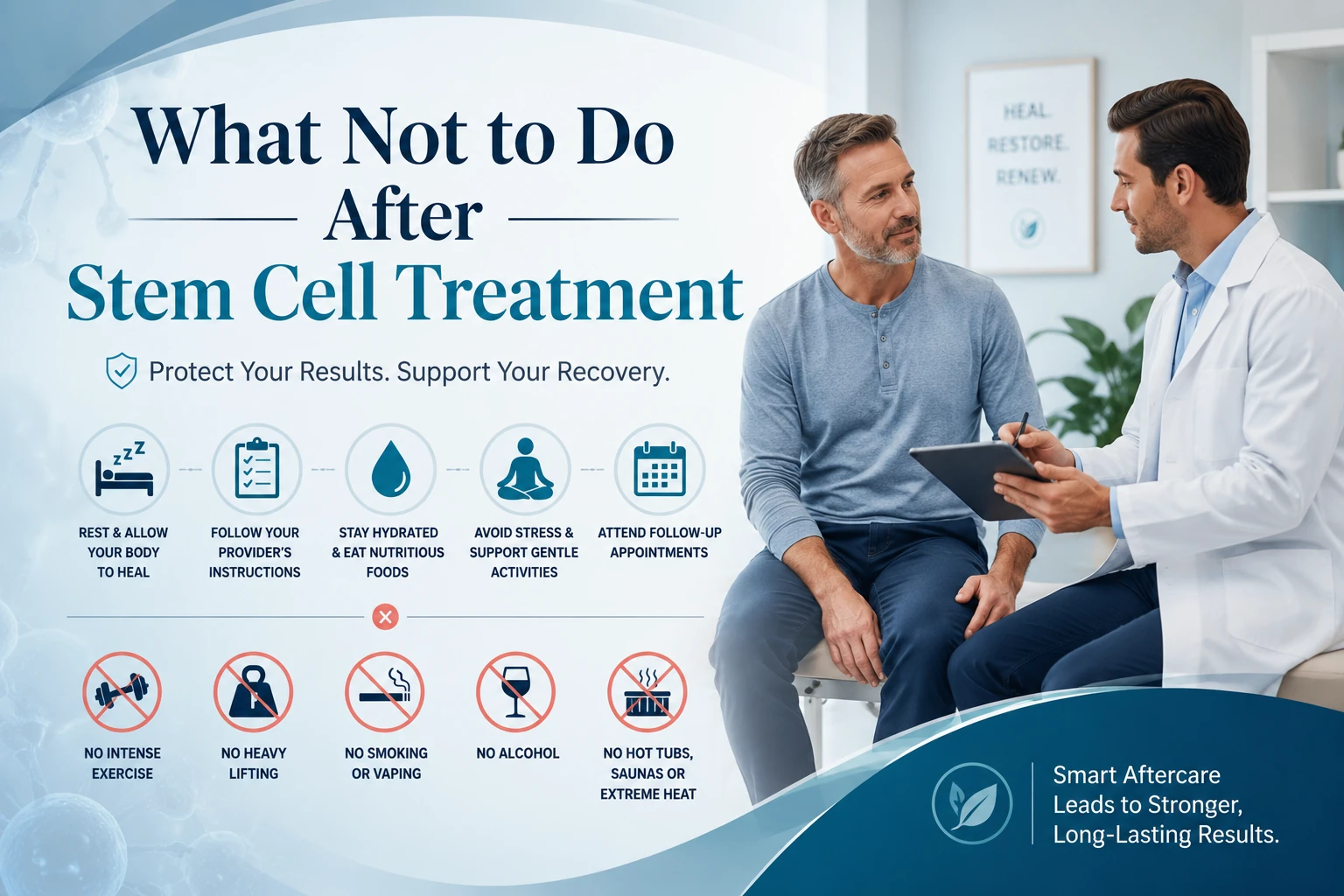
Skipping NSAIDs, hard workouts, alcohol, and nicotine for the first few weeks after stem cell treatment protects the inflammatory response your cells need to work.
This guide covers the mistakes that quietly undo results, the warning signs that need a call to your provider, and a week-by-week timeline for easing back into normal life.
SEE IF CELL THERAPY IS RIGHT FOR YOU
What Should You Avoid After Stem Cell Treatment?
The biggest mistakes after stem cell treatment are taking NSAIDs like ibuprofen or naproxen, returning to strenuous exercise too soon, smoking or using nicotine, drinking alcohol, skipping sleep, and missing follow-up appointments.
Each of these interferes with the inflammatory signaling your cells rely on to repair damaged tissue.
You spent real time and money getting stem cell therapy for a knee, hip, shoulder, or another joint that’s been holding you back.
What you do in the days and weeks afterward has just as much influence on your outcome as the injection itself.
A single dose of the wrong medication or a workout that comes a week too early can blunt results you were counting on.
GET THE MOST OUT OF STEM CELL THERAPY
Why These Mistakes Can Undo Your Results
Stem cell therapy doesn’t work by simply dropping new cells into damaged tissue and walking away.
Adipose-derived mesenchymal stem cells, the type used in most orthopedic treatments, need a specific inflammatory environment to migrate to the injury site, signal nearby tissue, and begin the repair process.
That inflammation is the mechanism, not a side effect to suppress.
This is exactly why post-procedure guidelines are so consistent across clinics.
A 2025 scoping review of 200 studies on orthobiologic post-procedure protocols found that 91.2% restricted NSAIDs in some form, with the average restriction lasting 163 days after the procedure.
That’s not a cautious suggestion.
It reflects how broadly the medical field agrees that certain everyday habits can interfere with cell-based treatments.
Everest Regenerative Medicine’s adipose-derived stem cell therapy works by harnessing your own biology to repair joints, tendons, and soft tissue, which means your body’s post-treatment environment matters as much as the cells themselves.
Don’t Take NSAIDs or Other Anti-Inflammatory Medication
Avoid ibuprofen, naproxen, aspirin, and other NSAIDs after stem cell treatment because they block the inflammatory signals your cells depend on to differentiate and repair tissue.
Use acetaminophen for pain relief instead, and check with your provider before restarting any anti-inflammatory medication.
The biology behind this is well documented.
Lab research shows aspirin can inhibit the growth of mesenchymal stem cells by up to 62% at higher concentrations, slowing their ability to multiply and repair tissue.
Other NSAIDs have been shown to downregulate TGF-β3, a protein essential to bone and cartilage healing, during the exact window when your cells are trying to integrate.
This isn’t limited to prescription-strength medication.
Natural anti-inflammatories like high-dose turmeric, fish oil, and arnica can have a similar dampening effect and are worth pausing during early recovery unless your provider says otherwise.
If you’re managing chronic joint pain, it can be tempting to reach for your usual medication the moment discomfort returns.
Give your provider a call first.
Don’t Rush Back Into Strenuous Exercise
Avoid running, heavy lifting, high-impact cardio, and contact sports for at least two to four weeks after stem cell treatment, or longer depending on the joint treated.
Gentle walking is generally fine within the first few days, but anything that stresses the treated area too early can disrupt the healing tissue before it has a chance to stabilize.
Newly forming tissue is fragile.
Loading it with the same intensity you were using before treatment, especially in a knee, hip, or shoulder, can reopen microscopic damage the cells are still working to repair.
This is one reason providers who focus on athletic performance and recovery build return-to-activity plans in stages rather than clearing patients for a single fixed date.
A general rule that holds up across most joints: if an activity causes pain during or after, it’s too soon.
Physical therapy, when your provider recommends it, should guide the pace of your return rather than your own timeline.
Don’t Smoke or Use Nicotine Products
Smoking and nicotine use reduce blood flow and directly impair how stem cells behave, so avoiding tobacco and vaping products is one of the most important things you can do after treatment.
Nicotine’s effects on circulation and cell function can persist for weeks, not just the day of your procedure.
A review in Stem Cells Translational Medicine found that cigarette smoke and nicotine reduce the proliferation, migration, and differentiation capacity of mesenchymal stem cells, the exact functions these treatments depend on.
Nicotine constricts blood vessels, which means less oxygen and fewer nutrients reach the treated area right when your body needs them most.
If quitting outright isn’t realistic, even a temporary pause during the first several weeks of recovery gives your cells a meaningfully better environment to work in.
Don’t Drink Alcohol During Early Recovery
Skip alcohol for at least two to four weeks after stem cell treatment, since it interferes with the same repair pathways your cells rely on and can slow healing at the tissue level.
Alcohol also dehydrates you, which compounds the problem during a period when your body needs extra fluid to support recovery.
The research on this is fairly stark.
In one study, ethanol exposure reduced new blood vessel formation by up to 61% and collagen content by up to 37% at injury sites, both of which are critical to how repaired tissue rebuilds itself.
Chronic alcohol use has also been shown to delay skeletal muscle regeneration following injury, with more fibrosis and slower recovery of muscle fiber size.
Alcohol disrupts the signaling that damaged tissue sends out to coordinate repair, which is precisely the process your treatment is trying to support.
Don’t Sacrifice Sleep While You’re Healing
Prioritize sleep after stem cell treatment because your body releases most of its growth hormone during deep sleep, and that hormone drives the tissue repair and protein synthesis your recovery depends on.
Aim for consistent, uninterrupted sleep rather than pushing through short nights.
Research on sleep and physiological recovery shows that insufficient sleep disrupts hormone balance, raising cortisol while reducing testosterone and growth hormone, the same anabolic hormones your body needs for repair.
Skipping sleep to squeeze in more activity or stress about work during recovery works against the treatment you just invested in.
If you’re also using peptide therapy for healing alongside stem cell treatment, sleep matters even more, since many of these peptides work through the same growth hormone pathways that are most active overnight.
GET THE MOST OUT OF YOUR STEM CELL TREATMENT
Don’t Ignore Warning Signs That Need Medical Attention
Call your provider right away if you notice worsening pain, significant swelling, redness, warmth, fever, or reduced range of motion at the injection site.
These can be signs of infection, and while rare, they require prompt treatment to avoid lasting joint damage.
Infection after a joint injection is uncommon, with published estimates ranging from about 1 in 3,000 to 1 in 50,000 injections.
But when it happens, the window for effective treatment is narrow.
Some soreness, mild swelling, and stiffness are a normal part of the healing process, especially in the first several days.
The difference is trajectory: normal discomfort gradually improves, while a true complication tends to get sharply worse rather than better.
When in doubt, call rather than wait.
Don’t Skip Your Follow-Up Appointments
Attend every follow-up appointment your provider schedules, even if you’re feeling great.
These visits are how your provider tracks your progress, catches problems early, and adjusts your recovery plan if something isn’t going as expected.
Stem cell therapy and PRP treatments both rely on gradual biological changes that unfold over weeks and months, not overnight.
Without follow-up visits, it’s easy to miss early signs that a treatment plan needs adjusting, or to misjudge when it’s actually safe to resume normal activity.
A Week-by-Week Timeline for What to Avoid
Every recovery timeline should ultimately be set by your provider based on the joint treated and your individual healing response.
That said, here’s a general framework for what most patients can expect.
Weeks 1 to 2: Protect the Treatment Site
Avoid NSAIDs, alcohol, nicotine, and anything beyond light walking.
This is when inflammation is doing its most important work, and it’s also when patients are most tempted to reach for ibuprofen out of habit.
Weeks 3 to 4: Ease Back Slowly
Light activity and provider-approved physical therapy can typically begin, but strenuous exercise, heavy lifting, and high-impact movement should still wait.
This is also a good time for your first follow-up if you haven’t had one yet.
Month 2 and Beyond: Watch, Don’t Rush
Most patients can gradually return to normal activity by this point, but full results from treatments like stem cell therapy for knee pain or stem cell therapy for back pain often continue to develop over several months.
Knowing when to expect results helps you avoid the common mistake of assuming treatment failed simply because change is gradual.
How Everest Regenerative Medicine Supports Your Recovery
At Everest Regenerative Medicine aftercare isn’t an afterthought here.
It’s treated as part of the treatment itself.
Patients across Fargo, West Fargo, and the wider North Dakota, Minnesota, and South Dakota region come to Everest for adipose-derived stem cell therapy because it uses their own cells, lab-expanded and prepared to give your body the best possible starting point for repair.
Every patient leaves with a clear, individualized recovery plan, not a generic handout, because the right restrictions depend on the joint treated and your overall health.
For patients who want to plan ahead, Everest also offers stem cell banking, preserving your own cells now for future use.
And for those recovering from joint pain who may benefit from a complementary approach, the clinic’s shockwave therapy can support tissue healing alongside regenerative treatment.
Follow-up visits are built into every plan, so you’re never guessing whether you’re on track.
FAQs: What Not to Do After Stem Cell Treatment
How long after stem cell treatment can I take ibuprofen or other NSAIDs?
Most providers ask patients to avoid NSAIDs for at least several weeks, and sometimes up to a few months, after stem cell treatment. Research on post-procedure protocols shows restrictions commonly last well over 100 days. Always follow your specific provider’s timeline rather than a general rule, and use acetaminophen for pain relief in the meantime.
When can I go back to the gym after stem cell therapy?
Light walking is usually fine within the first few days, but strenuous exercise, heavy lifting, and high-impact activity typically need to wait two to four weeks or longer, depending on the joint treated. Your provider will clear you for specific activities based on how your recovery is progressing.
Is it really necessary to avoid alcohol after stem cell injections?
Yes. Alcohol has been shown to reduce blood vessel formation and collagen production at injury sites, both of which are important to how repaired tissue rebuilds. Avoiding alcohol for at least two to four weeks gives your body a better environment to heal in.
What warning signs should I never ignore after stem cell treatment?
Contact your provider immediately if you notice rapidly worsening pain, significant swelling, redness, warmth, fever, or a sudden loss of range of motion. These can indicate infection and need prompt evaluation, unlike normal post-treatment soreness, which gradually improves rather than getting sharply worse.
How long does it take to see results from stem cell therapy?
Many patients notice gradual improvement over one to three months, with results continuing to develop for up to six months as the treated tissue remodels. Results vary by individual and by the joint or condition treated, so patience during the early weeks matters as much as following aftercare instructions.
Can I keep taking my regular prescription medications after treatment?
In most cases, yes, but you should review your full medication list with your provider before treatment so they can flag anything that might interfere with healing, such as blood thinners or anti-inflammatory drugs. Never stop a prescribed medication without talking to the doctor who prescribed it.