
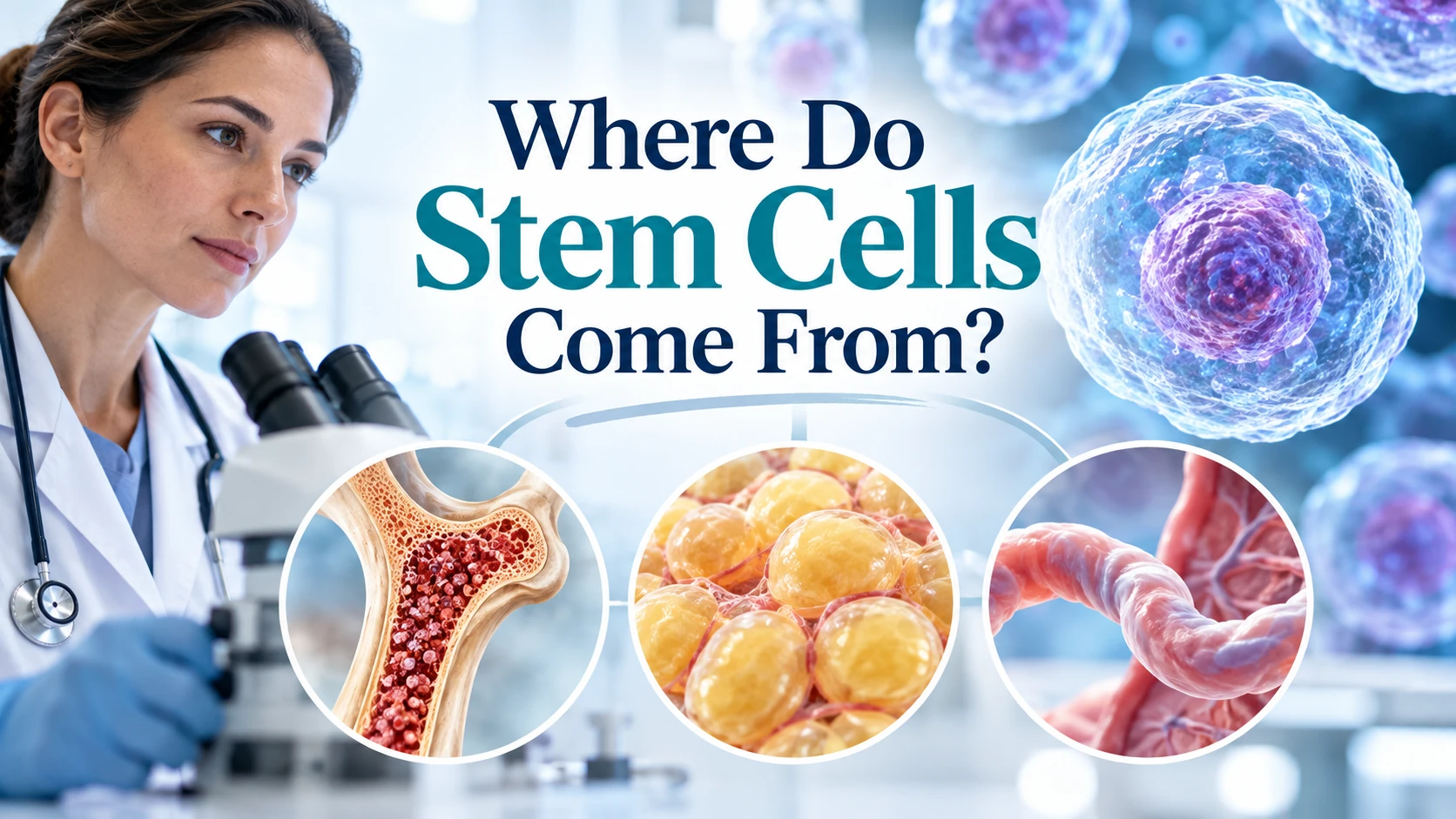
Stem cells come from four main sources: embryos, adult tissue like bone marrow and fat, umbilical cord blood and tissue saved after birth, and adult cells reprogrammed in a lab into induced pluripotent stem cells (iPSCs).
Each source has different properties and uses.
Most regenerative medicine clinics today work with autologous stem cells, meaning cells collected from your own body and used the same day under FDA guidelines, rather than embryonic cells.
If you’ve ever wondered where do stem cells come from, you’re asking a bigger question than you might realize.
Stem cells aren’t one single thing collected from one single place.
They come from several different sources, each with its own story, its own science, and its own role in modern medicine.
Whether you’re curious about the biology, researching options for joint pain, or just trying to separate fact from marketing hype, this guide breaks down exactly where stem cells come from, how doctors use them today, and what that means for your own health.
SEE IF STEM CELL THERAPY IS RIGHT FOR YOU
What Are Stem Cells, Exactly?
Stem cells are the body’s raw materials.
They’re cells that haven’t decided what to become yet, and they have the unique ability to divide and turn into many different, more specialized cell types, like muscle, bone, nerve, or blood cells.
Every other cell in your body has a job.
A skin cell is a skin cell.
A heart cell is a heart cell.
Stem cells are different.
They’re still unspecialized, which means they can renew themselves through cell division and, under the right conditions, transform into the specific cell types your body needs.
That flexibility is why researchers and doctors are so interested in them.
Stem cells act as the foundation of how the human body builds, maintains, and repairs itself, from the moment an embryo starts developing to the ongoing repair work your body does every day.
Not every stem cell can become everything, though.
Scientists describe this range as “potency.”
A fertilized egg is totipotent, meaning it can become any cell in a full organism, including the placenta.
Embryonic stem cells are pluripotent, meaning they can become almost any cell type in the body, but not a full organism on their own.
Adult stem cells are usually multipotent, limited to related cell types within their own tissue, like a bone marrow stem cell that can become bone, cartilage, or fat, but not a nerve cell.
Where Do Stem Cells Come From? The Four Main Sources
Stem cells come from four main sources: embryos in the earliest stage of development, adult tissue such as bone marrow and fat, perinatal tissue like umbilical cord blood collected after birth, and lab-reprogrammed adult cells called induced pluripotent stem cells.
Each source carries a different potency level, different benefits, and different limitations.
Here’s what makes each one distinct, and why clinics and researchers reach for different sources depending on the goal.
Embryonic Stem Cells
Embryonic stem cells come from a blastocyst, an embryo about three to five days old.
At this stage, the embryo is a hollow ball of around 150 cells, and scientists can extract cells from its inner layer.
These cells are pluripotent, meaning they can become almost any cell type in the body.
Most embryonic stem cell lines used in research come from embryos created during IVF that were never going to be implanted and were donated with consent, not fertilized specifically for research.
Because of how they’re obtained, embryonic stem cells remain the most ethically and legally debated source, something we’ll come back to later in this guide.
Adult (Somatic) Stem Cells
Adult stem cells, also called somatic stem cells, live inside fully developed tissue, most often bone marrow and fat (adipose tissue).
Unlike embryonic stem cells, they’re already present in your body right now.
Bone marrow is the most studied source.
Mesenchymal stem cells sit inside bone marrow at a very low natural frequency, roughly one stem cell for every 34,000 other cells in the marrow, which is why providers often concentrate them before use.
Adipose tissue, or body fat, contains a much higher concentration of stem cells than bone marrow and can be collected through a simpler, less invasive procedure like a mini-liposuction.
That’s part of why fat has become a popular source for regenerative treatments.
Perinatal Stem Cells (Umbilical Cord and Placenta)
Perinatal stem cells come from tissue connected to childbirth: umbilical cord blood, cord tissue, and the placenta.
None of this requires harming an embryo or fetus, since it’s collected after a baby is born and the cord is already being clamped and cut.
Cord tissue contains a gel-like substance called Wharton’s jelly, which is especially rich in mesenchymal stem cells.
Research shows Wharton’s jelly stem cells divide faster and last longer in culture than stem cells taken from bone marrow or fat, which makes them attractive for certain therapeutic uses.
This is also why some parents choose to bank their newborn’s cord blood and tissue.
It’s a one-time opportunity.
Once the cord is discarded, that specific source is gone for good.
Induced Pluripotent Stem Cells (iPSCs)
iPSCs aren’t collected from an embryo, cord, or bone marrow at all.
They’re made in a lab, starting with an ordinary adult cell, often a skin or blood cell.
In 2006, Japanese scientist Shinya Yamanaka discovered that introducing four specific genes into a mature cell could reprogram it back into a pluripotent, embryonic-like state, without ever touching an embryo.
The discovery earned him the 2012 Nobel Prize in Physiology or Medicine.
iPSCs matter because they offer many of the same research possibilities as embryonic stem cells, but without the ethical debate, since they start from a consenting adult’s own cells.
Common Places Stem Cells Are Found in the Body
Beyond the four sources above, stem cells also live naturally in specific places throughout your body.
Each location serves a different ongoing repair job.
Bone marrow houses both hematopoietic stem cells, which make blood cells, and mesenchymal stem cells, which can become bone, cartilage, or fat.
Your blood itself carries circulating hematopoietic stem cells, which is why some transplants use a blood draw instead of a marrow biopsy.
Fat tissue, skin, dental pulp inside teeth, the lining of your gut, and even small pockets in the brain all contain their own reserves of adult stem cells.
A comprehensive review of stem cell origins notes that nearly every tissue in the body maintains some population of resident stem cells for ongoing maintenance and repair, even though most of these reserves are too small or too hard to access for clinical use.
That’s part of why bone marrow, fat, and cord tissue dominate real-world treatment.
They offer the best combination of stem cell concentration and accessibility.
Autologous vs. Allogeneic: Does Where the Cells Come From Matter?
Yes.
Autologous stem cells come from your own body and carry no risk of rejection, while allogeneic stem cells come from a donor and must be matched and screened carefully.
Which one a provider uses changes the procedure, the regulations involved, and sometimes the outcome.
Autologous treatment means a provider takes cells from your bone marrow or fat, processes them, and gives them back to you, often in the same visit.
Since the cells are already yours, your immune system doesn’t treat them as foreign material.
Allogeneic treatment uses cells from a donor, which is standard for certain blood cancer treatments but far less common in outpatient regenerative medicine.
A 2025 review comparing autologous and allogeneic adipose-derived stem cells for knee osteoarthritis found that cells sourced from the patient’s own body tended to relieve pain more quickly, while donor-sourced cells showed more sustained effects in some patients.
This is part of why providers choose between different types of stem cell therapy based on your specific condition, rather than a one-size-fits-all approach.
Where Do Doctors Get Stem Cells for Treatment Today?
Most U.S. regenerative medicine providers use autologous adult stem cells pulled from a patient’s own bone marrow or fat during an in-office procedure.
Under FDA rules, these cells can be minimally processed and given back the same day without requiring drug approval, as long as they’re used for a closely related purpose.
In practice, this usually looks like one of two procedures.
A bone marrow aspiration draws marrow-rich fluid from the hip bone.
A mini-liposuction collects a small amount of fat tissue, which is processed into a concentrate sometimes called stromal vascular fraction.
The FDA allows this same-day, minimally manipulated approach under what’s known as Section 361, as long as the cells aren’t significantly altered and are used for a function similar to their original one.
Not every state agrees on where the line should be drawn.
For conditions like joint pain and osteoarthritis, this means your own bone marrow or fat is almost always the source, not a donor, a lab-grown line, or an embryo.
If a provider can’t clearly explain where your cells are coming from, that’s worth questioning.
SEE IF STEM CELL THERAPY IS RIGHT FOR YOU
How Everest Regenerative Medicine Uses Stem Cells for Healing
At Everest Regenerative Medicine, we work almost exclusively with your own cells.
That’s a deliberate choice, not a limitation.
Using your own bone marrow or fat-derived stem cells means no donor matching, no waiting list, and no foreign tissue for your body to react to.
Not every joint, tendon, or condition responds to regenerative medicine the same way, so we walk through your specific situation before recommending anything.
For patients who want to plan ahead, stem cell banking lets you preserve your own cells now, while they’re younger and healthier, for potential future use.
It’s the same logic as cord blood banking, applied to your own adult stem cells.
We also talk openly with patients about how stem cell therapy compares to PRP therapy, since PRP uses your own blood platelets rather than stem cells and is sometimes the more appropriate starting point depending on your condition.
Stem cells come from embryos, your own adult tissue, birth tissue, and reprogrammed lab cells, and each source plays a different role in medicine today.
For most people exploring regenerative treatment for pain or injury, the real answer to where do stem cells come from is refreshingly simple: your own body, collected and used the same day.
If you’re curious whether this approach could help your own joint pain, injury, or recovery, Everest Regenerative Medicine can walk you through exactly where your cells would come from and what to realistically expect.
FAQs: Where Do Stem Cells Come From
Can stem cells come from your own body?
Yes. This is called an autologous source, and it’s the most common approach in regenerative medicine today. Providers typically collect cells from your bone marrow or fat tissue and use them in the same procedure.
Are stem cells still taken from embryos?
Embryonic stem cells are still used in research, usually from donated IVF embryos that were never going to be implanted. They’re rarely used in outpatient treatment, where adult and birth-tissue sources are far more common.
Do stem cell treatments use someone else’s cells?
Sometimes, but it’s less common outside of certain blood cancer treatments. Donor-sourced cells are called allogeneic, and they require careful screening and matching before use.
Is stem cell therapy legal in the United States?
Yes, when it follows FDA guidelines. Same-day procedures using your own minimally processed cells for a closely related purpose are legal and widely practiced. Treatments that significantly alter cells or use them for unrelated purposes face stricter FDA drug approval requirements.
How are stem cells collected for regenerative medicine?
Most commonly through a bone marrow aspiration from the hip bone or a mini-liposuction to collect fat tissue. Both are outpatient procedures that take a small sample, concentrate it, and return it to the treatment area the same day.
Can stem cells be grown in a lab?
Yes. Induced pluripotent stem cells are made by reprogramming ordinary adult cells, like skin or blood cells, back into a flexible, stem-cell-like state. This happens entirely in a lab setting, without an embryo or donor involved.