
Yes.
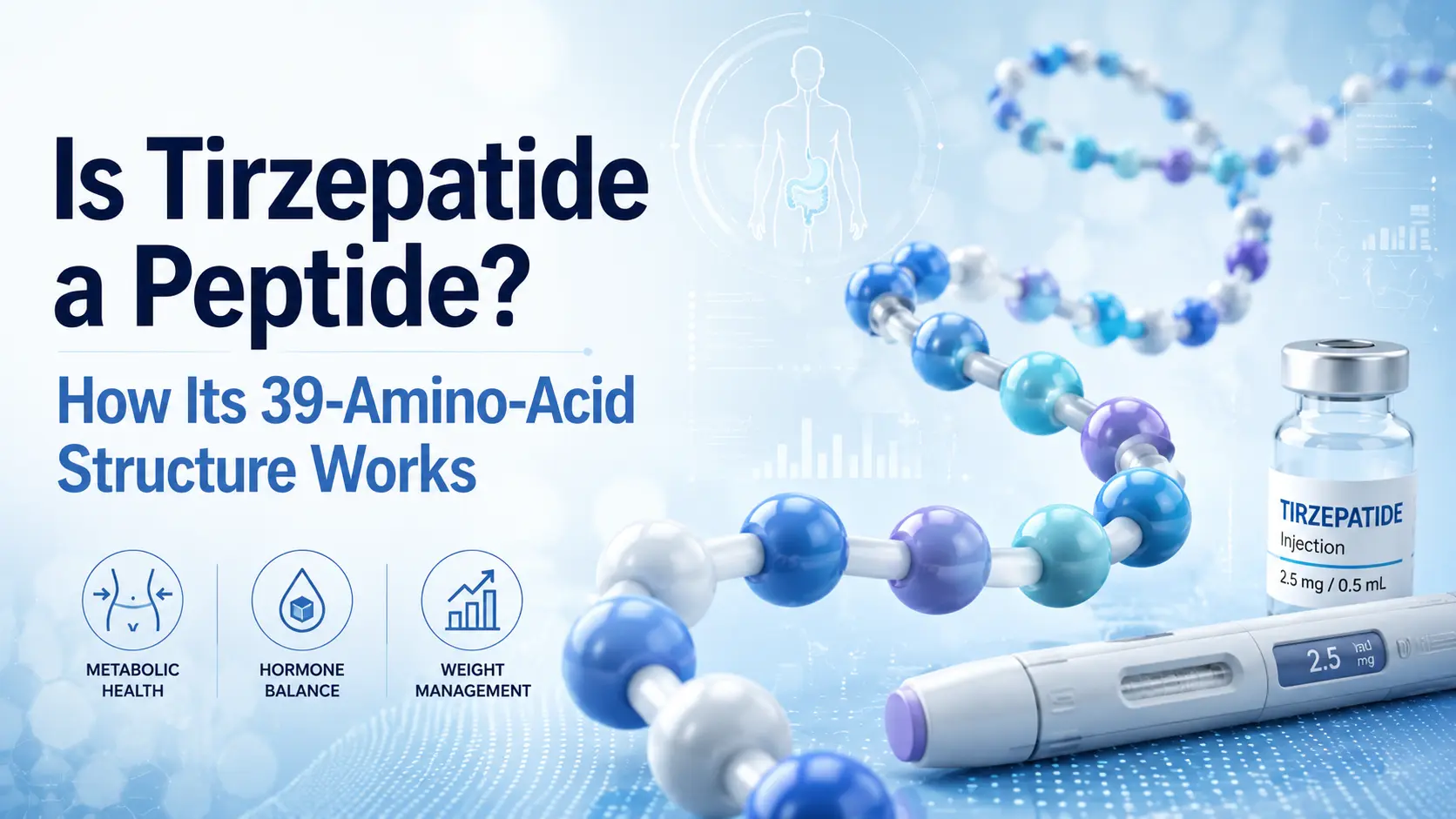
Tirzepatide is a synthetic, modified peptide made from 39 amino acids.
It activates both GIP and GLP-1 receptors, which makes it a dual incretin receptor agonist rather than a GLP-1-only medication.
Its peptide structure helps explain how tirzepatide interacts with metabolic receptors, why it is administered by injection, and how it remains active long enough for once-weekly dosing.
SEE IF TIRZEPATIDE IS RIGHT FOR YOU
What Makes Tirzepatide a Peptide?
A peptide is a chain of amino acids connected by peptide bonds.
Amino acids are often called the building blocks of proteins, but shorter amino-acid chains are generally classified as peptides.
Tirzepatide contains 39 amino acids arranged in a specific sequence.
That is why it is described as a synthetic peptide rather than a traditional small-molecule medication.
However, tirzepatide is not simply a copy of a naturally occurring peptide.
It is a modified peptide designed to reproduce and extend certain effects of the natural incretin hormones GIP and GLP-1.
Its structure is based primarily on the natural GIP sequence, with engineered changes that allow it to activate both GIP and GLP-1 receptors.
Additional structural modifications help it remain active in the body much longer than naturally produced incretin hormones.
What Type of Peptide Is Tirzepatide?
Tirzepatide can be described in several ways because each term explains a different part of its structure or mechanism.
| Description | What It Means |
| Synthetic peptide | Tirzepatide is manufactured using a specific engineered amino-acid sequence |
| Modified peptide | Its structure has been adjusted to improve receptor activity and extend how long it remains active |
| 39-amino-acid peptide | Its main peptide chain contains 39 connected amino acids |
| Peptide medication | Its peptide-based structure is used for a therapeutic purpose |
| GIP receptor agonist | It activates receptors associated with the natural GIP hormone |
| GLP-1 receptor agonist | It also activates receptors associated with the natural GLP-1 hormone |
| Dual incretin receptor agonist | It works through both GIP and GLP-1 pathways |
The word “peptide” describes what tirzepatide is made from.
The term “dual GIP/GLP-1 receptor agonist” describes how it works.
Is Tirzepatide a Peptide or a GLP-1?
Tirzepatide is both a peptide and a medication that activates the GLP-1 receptor.
These terms do not describe the same feature:
- Peptide describes tirzepatide’s molecular structure.
- GLP-1 receptor agonist describes one part of its biological activity.
- Dual GIP/GLP-1 receptor agonist is the more complete description of its mechanism.
Tirzepatide is often grouped with GLP-1 medications because it activates the GLP-1 receptor.
However, calling it only a GLP-1 medication leaves out its activity at the GIP receptor.
GIP and GLP-1 are both incretin hormones.
The digestive system releases incretin hormones after food is consumed, helping coordinate insulin release, blood sugar regulation, digestion, appetite, and feelings of fullness.
Because tirzepatide activates both receptor pathways, it is more accurately described as a dual incretin receptor agonist.
How Tirzepatide’s Peptide Structure Affects How It Works
Tirzepatide’s effects depend on more than the number of amino acids it contains.
The sequence, shape, and chemical modifications of the molecule determine which receptors it can activate and how long it remains active.
Its 39-Amino-Acid Sequence Targets GIP and GLP-1 Receptors
Tirzepatide’s amino-acid sequence allows it to bind to GIP and GLP-1 receptors in different parts of the body.
Activating these receptors can influence:
- Glucose-dependent insulin release
- Glucagon signaling
- Appetite and hunger cues
- Feelings of fullness
- The rate at which food leaves the stomach
- Blood sugar regulation after meals
These processes are connected.
Tirzepatide does not work as a stimulant or directly dissolve body fat.
Instead, it changes biological signals involved in food intake, digestion, insulin response, and metabolic function.
Its Fatty Diacid Modification Extends Its Activity
Tirzepatide includes a fatty diacid component attached to its peptide chain.
This modification helps the molecule bind to albumin, a protein that circulates in the blood.
Albumin binding slows how quickly tirzepatide is cleared from the body.
Natural GIP and GLP-1 hormones break down rapidly, but tirzepatide’s modified structure allows it to remain active for several days.
This extended activity supports once-weekly dosing rather than requiring daily or multiple daily administration.
Its Peptide Structure Helps Explain Why It Is Injected
Peptides can be broken down by stomach acid and digestive enzymes.
If an unprotected peptide is swallowed, the digestive system may separate it into smaller components before enough of the intact molecule can enter circulation.
Tirzepatide is therefore administered as a subcutaneous injection, which delivers it into the tissue beneath the skin.
This allows the intact peptide to enter the body without first passing through the digestive system.
Its peptide structure also means that proper storage and handling matter.
Temperature, light, and physical damage can affect some peptide medications, so patients should follow the storage instructions provided with the medication and by their healthcare professional.
Is Tirzepatide a Peptide, Protein, or Hormone?
Tirzepatide is most accurately classified as a synthetic peptide medication.
| Classification | Does It Apply? | Explanation |
| Peptide | Yes | Tirzepatide has a modified 39-amino-acid peptide backbone |
| Protein | Not usually | It is generally classified as a peptide rather than a larger, more complex protein |
| Natural hormone | No | Tirzepatide is synthetic and is not naturally produced by the human body |
| Hormone mimetic | Yes | It imitates selected signals associated with natural incretin hormones |
| Incretin receptor agonist | Yes | It activates both GIP and GLP-1 receptors |
Tirzepatide is not itself a naturally occurring hormone.
It is designed to act on receptors used by GIP and GLP-1, which are natural hormones released by the digestive system.
This is why tirzepatide may also be described as an incretin mimetic or incretin-based medication.
It mimics certain hormonal signals without being identical to the hormones naturally produced by the body.
Tirzepatide vs Semaglutide: Are Both Peptides?
Tirzepatide and semaglutide are both synthetic peptide medications, but they do not work in exactly the same way.
| Comparison | Tirzepatide | Semaglutide |
| Molecular category | Synthetic peptide | Synthetic peptide |
| Main receptor targets | GIP and GLP-1 | GLP-1 |
| Common classification | Dual GIP/GLP-1 receptor agonist | GLP-1 receptor agonist |
| Number of incretin pathways targeted | Two | One |
| Common injectable dosing frequency | Once weekly | Once weekly |
The main difference is receptor activity.
Semaglutide activates the GLP-1 receptor, while tirzepatide activates both GIP and GLP-1 receptors.
That difference does not mean one medication is right for every person.
Individual responses may vary based on health history, blood sugar regulation, digestive tolerance, nutrition, activity level, sleep, hormone health, and other medications.
Is Tirzepatide the Same as Peptide Therapy?
Tirzepatide is one type of peptide-based treatment, but tirzepatide and peptide therapy are not interchangeable terms.
“Peptide therapy” is a broad phrase that may refer to many different peptides used or studied for different purposes.
These peptides may be associated with metabolic signaling, hormone pathways, recovery, digestive function, immune activity, or other biological processes.
Tirzepatide is one specific synthetic peptide with:
- A defined 39-amino-acid structure
- A modified chemical design
- Activity at GIP and GLP-1 receptors
- A long-acting weekly dosing profile
The fact that two treatments are both peptide-based does not mean they work in the same way, have the same supporting evidence, or carry the same risks.
Each peptide should be evaluated individually based on its mechanism, intended use, quality, supporting research, potential side effects, and the patient’s medical needs.
Is Tirzepatide a Biologic?
Tirzepatide is a synthetic peptide medication, but “peptide” and “biologic” are not interchangeable terms.
The term peptide describes the molecule’s amino-acid structure.
The term biologic is a regulatory and manufacturing classification that may apply to certain products derived from living systems or made through specific biological processes.
For patients, the more useful description is that tirzepatide is a synthetic, modified peptide and dual GIP/GLP-1 receptor agonist.
Why Does Tirzepatide’s Classification Matter?
Understanding that tirzepatide is a peptide helps explain several important features of the medication.
First, it explains why tirzepatide is structurally different from many traditional oral medications.
Its amino-acid chain is designed to interact with specific metabolic hormone receptors.
Second, its peptide structure helps explain why it is injected instead of taken as a standard tablet.
Digestive enzymes could break down the intact peptide before it reaches circulation.
Third, its modified structure helps it remain active longer than natural incretin hormones.
This makes once-weekly dosing possible.
Finally, identifying tirzepatide as a peptide does not automatically tell a patient whether it is appropriate for them.
Its receptor activity, medical risks, potential benefits, and side-effect profile must also be considered.
What Should Patients Know Before Considering Tirzepatide?
Tirzepatide’s peptide structure does not make it suitable for everyone.
Treatment should begin with a medical assessment rather than a decision based only on appetite changes or potential weight loss.
A provider may review:
- Current medications
- Blood sugar history
- Previous treatment attempts
- Digestive health
- Kidney and gallbladder history
- Pancreatic concerns
- Pregnancy plans
- Personal and family medical history
- Nutrition and activity habits
Common side effects may include nausea, diarrhea, vomiting, constipation, abdominal discomfort, indigestion, and reduced appetite.
These effects may be more noticeable when treatment begins or after the dose changes.
Tirzepatide also carries more serious risks and may not be appropriate for people with certain medical histories.
Patients should review potential contraindications, warnings, and medication interactions with a qualified healthcare provider before beginning treatment.
Ongoing monitoring can help assess progress, manage side effects, support adequate nutrition and hydration, and reduce the risk of losing excessive muscle mass during weight reduction.
Personalized Tirzepatide Guidance in West Fargo, ND
Understanding tirzepatide’s peptide structure answers one question.
Determining whether it fits a person’s health needs requires a more individualized evaluation.
Everest Regenerative Medicine provides personalized wellness and metabolic care in West Fargo, North Dakota.
The evaluation process may include a review of symptoms, health history, current medications, previous treatment approaches, lifestyle factors, and relevant health markers.
Ongoing follow-up allows the medical team to evaluate progress, address side effects, adjust the treatment approach when appropriate, and help patients build sustainable nutrition and lifestyle habits alongside medical care.
Final Thoughts: Is Tirzepatide a Peptide?
Tirzepatide is a synthetic, modified peptide composed of 39 amino acids.
Its engineered structure allows it to activate both GIP and GLP-1 receptors, making it a dual incretin receptor agonist rather than a GLP-1-only medication.
Its peptide structure helps explain why it is administered by injection, how it interacts with specific metabolic receptors, and why structural modifications allow it to remain active long enough for weekly dosing.
However, classification is only one part of the discussion.
Whether tirzepatide is appropriate depends on a person’s medical history, treatment goals, potential risks, and response to care.
Those factors should be evaluated with guidance from a qualified healthcare provider.
FAQs
Is tirzepatide considered a peptide?
Yes. Tirzepatide is a synthetic, modified peptide made from a chain of 39 amino acids. It is designed to activate both GIP and GLP-1 receptors.
What type of peptide is tirzepatide?
Tirzepatide is a long-acting synthetic peptide and dual GIP/GLP-1 receptor agonist. Its structure is based primarily on natural GIP but includes engineered modifications.
Is tirzepatide a peptide or a GLP-1?
It is both. Tirzepatide is a peptide by structure and activates the GLP-1 receptor as part of its mechanism. It also activates the GIP receptor.
Is tirzepatide natural or synthetic?
Tirzepatide is synthetic. It is designed using features of natural incretin hormones but includes modifications that change its receptor activity and duration.
Does tirzepatide burn fat?
Tirzepatide does not directly burn fat like a stimulant or fat-burning supplement. It affects appetite and calorie intake through GIP and GLP-1 receptor activity, which can support weight loss over time. Clinical data show that tirzepatide-related weight reduction includes greater fat-mass loss than lean-mass loss, although maintaining adequate protein intake and resistance exercise may help preserve muscle.
How long does tirzepatide take to work?
Tirzepatide begins acting after the first dose, but the timing of noticeable results varies. Some people may notice appetite or fullness changes during the first few weeks, while measurable weight loss typically develops gradually over several weeks and months. Tirzepatide reaches steady concentrations in the body after about four weeks of once-weekly use, and treatment studies evaluate its larger weight-related effects over many months.