
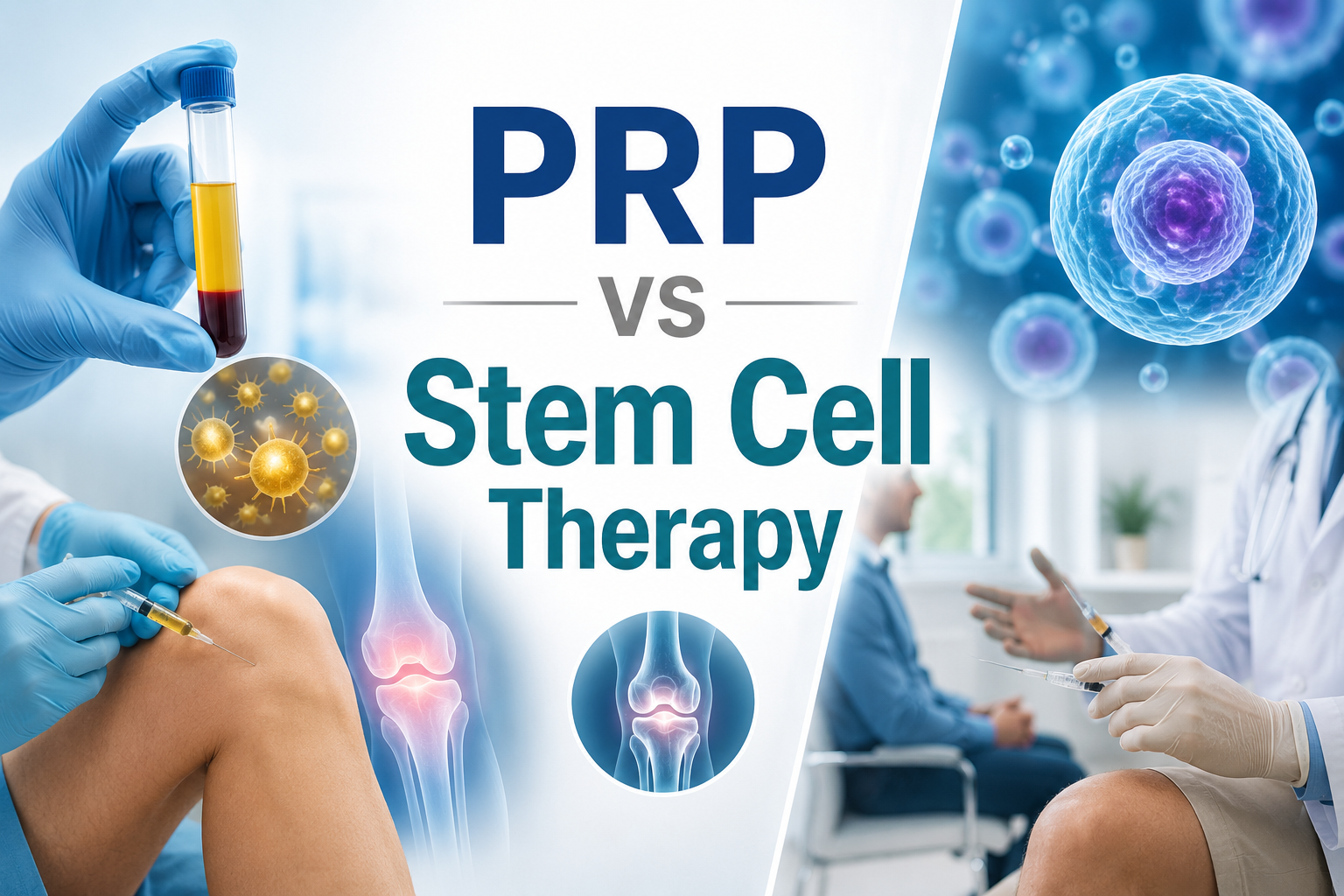
PRP and stem cell therapy are both used in regenerative medicine, but they are not the same treatment.
PRP uses concentrated platelets and signaling proteins taken from a sample of your blood.
Stem-cell-based procedures may use material collected from bone marrow, fat tissue, or another cellular source.
PRP is generally simpler, less invasive, and less expensive.
However, that does not mean it is always the better treatment.
It also does not mean a more complex stem-cell-based procedure will automatically produce better results.
The right option depends on your diagnosis, the tissue being treated, the extent of the damage, your health, your treatment goals, and the exact preparation being used.
GET HELP WITH REGENERATIVE MEDICINE
Key Takeaways
- PRP comes from blood and does not contain stem cells.
- “Stem cell therapy” can refer to several different products and procedures.
- PRP usually involves a simpler collection process and shorter recovery.
- Stem-cell-based procedures are usually more expensive and may require bone marrow or fat collection.
- Neither treatment has been proven to be better for every injury or joint condition.
- Improved pain and function do not necessarily mean that damaged cartilage or tissue has completely regrown.
PRP vs Stem Cell Therapy at a Glance
| Comparison | PRP Therapy | Stem-Cell-Based Therapy |
| Source | A sample of your blood | May come from bone marrow, fat tissue, or another source |
| Main components | Concentrated platelets, plasma, and signaling proteins | Varies and may include several cell types, platelets, growth factors, and tissue components |
| Collection process | Standard blood draw | May require bone marrow aspiration or fat collection |
| Procedure complexity | Generally simpler | Usually more involved |
| Invasiveness | Minimally invasive | Depends on how the material is collected |
| Recovery | Primarily related to the injection site | May involve both a harvesting site and an injection site |
| Evidence | Studied for several joint and tendon conditions | Varies widely by product, processing method, and condition |
| Results timeline | Usually develops gradually | Usually develops gradually |
| Guaranteed to regrow tissue? | No | No |
| Best choice | Depends on the diagnosis | Depends on the diagnosis and exact product |
Which Is Better: PRP or Stem Cell Therapy?
Neither PRP nor stem cell therapy is universally better.
PRP may be a reasonable option when a patient wants a less invasive procedure and there is research supporting its use for the diagnosed condition.
A stem-cell-based procedure may be considered in other situations, but the decision should depend on the specific cellular product and evidence, not simply because the treatment sounds more advanced.
Head-to-head studies involving knee osteoarthritis have often found that PRP and certain bone-marrow- or fat-derived procedures produce similar improvements in pain and function.
This means the more expensive or complicated treatment is not automatically the more effective one.
What Is PRP Therapy?
Platelet-rich plasma, commonly called PRP, is prepared from a sample of your own blood.
During the procedure, blood is drawn from your arm and placed in a centrifuge.
The centrifuge separates the blood into different layers, allowing the provider to prepare plasma containing a higher concentration of platelets.
Platelets are widely known for helping blood clot, but they also release signaling proteins involved in the body’s response to injury.
Once the PRP is prepared, it is injected into the targeted joint, tendon, ligament, muscle, or surrounding tissue.
PRP does not contain stem cells.
It is a blood-derived treatment that concentrates platelets and other biological signals at the treatment site.
Are All PRP Injections the Same?
No.
PRP is not one completely standardized product.
PRP preparations can differ based on:
- The amount of blood collected
- The centrifuge system
- Platelet concentration
- White blood cell content
- The amount of plasma injected
- The number of injections
- The treatment location
- Whether ultrasound guidance is used
Some preparations contain more white blood cells and are described as leukocyte-rich PRP.
Others contain fewer white blood cells and are known as leukocyte-poor PRP.
These differences matter because a PRP protocol studied for one condition may not be identical to the preparation offered in another setting.
What Does “Stem Cell Therapy” Mean?
“Stem cell therapy” is an umbrella term rather than one standardized orthopedic treatment.
Depending on the provider and procedure, it may refer to:
- Bone marrow aspirate
- Bone marrow aspirate concentrate, or BMAC
- Microfragmented adipose tissue
- Other fat-derived preparations
- Laboratory-expanded cells used in research settings
- Donor-derived cellular or tissue products
- Other treatments marketed using stem-cell-related terminology
These preparations are not interchangeable.
They may come from different sources, contain different biological components, and undergo different processing methods.
Before considering stem cell therapy, ask the provider exactly what will be collected and injected.
What Is Bone Marrow Aspirate Concentrate?
Bone marrow aspirate concentrate is commonly abbreviated as BMAC.
During a BMAC procedure, bone marrow is usually collected from the back of the pelvis.
The aspirate is then processed before being injected into the treatment area.
BMAC is not made entirely of stem cells.
It may contain:
- Multiple cell types
- Platelets
- Growth factors
- Cytokines
- Signaling proteins
- A relatively small number of mesenchymal stromal cells
Its proposed effects may involve communication between these components and the surrounding tissue.
It should not be described as simply placing a large number of new cartilage-producing cells into a damaged joint.
What Is Microfragmented Adipose Tissue?
Microfragmented adipose tissue is prepared from a person’s own fat.
A small amount of fat is collected and mechanically processed before it is injected.
The resulting preparation contains a mixture of cells, structural tissue, and signaling components.
Fat-derived tissue and BMAC are not the same treatment.
They come from different parts of the body and involve different collection and processing methods.
Are Exosomes the Same as Stem Cells?
No.
Exosomes are not cells.
They are small particles involved in communication between cells.
Although exosome treatments are sometimes discussed alongside PRP and stem cell therapy, they should not be treated as another name for stem cells.
PRP vs Stem Cell Therapy: What Are the Key Differences?
Let’s look at some of the main differences between PRP and stem cell therapy:
Source and Composition
PRP comes from blood and primarily contains concentrated platelets, plasma, and signaling proteins.
Stem-cell-based procedures may use material from bone marrow, fat tissue, or another source.
These preparations often contain a mixture of cells, platelets, proteins, and structural components.
Collection Process
PRP requires a standard blood draw.
A bone-marrow-based procedure may require an aspiration from the pelvis.
A fat-derived procedure may involve collecting adipose tissue through a separate harvesting process.
These additional steps make many cellular procedures more involved than PRP.
How the Treatments May Work
PRP is used to place concentrated platelets and biological signals near irritated or injured tissue.
These signals may influence inflammation, blood vessel formation, cell activity, and the healing response.
Cellular procedures may also affect inflammation, immune activity, and tissue signaling.
Their proposed benefits may come from the substances released by the cells and other components of the preparation.
Neither treatment should be described as reliably rebuilding damaged tissue from the ground up.
Procedure Complexity
A PRP procedure can often be completed with a blood draw, preparation, and injection during the same appointment.
Cellular procedures may include:
- Preparation of a harvesting site
- Local anesthetic
- Collection of bone marrow or fat
- Processing of the material
- Injection into the treatment area
- Recovery instructions for two different sites
PRP vs Stem Cell Therapy: Pros and Cons
| Treatment | Potential Advantages | Potential Limitations |
| PRP | Uses the patient’s blood, usually requires no separate harvesting procedure, generally costs less, and has been studied for several joint and tendon conditions | Results vary, more than one injection may be recommended, preparations are not fully standardized, and it does not reliably regrow cartilage |
| Stem-cell-based procedures | May contain a wider range of biological components and are being studied for several orthopedic conditions | Usually more invasive, generally costs more, may cause discomfort at the harvesting site, and research varies widely by product and condition |
A treatment’s advantages only matter when it is appropriate for the patient’s diagnosis.
SEE WHICH OPTION IS RIGHT FOR YOU
PRP vs Stem Cell Therapy for Knee Pain and Osteoarthritis
Knee osteoarthritis is one of the most frequently studied uses of PRP and cellular injections.
PRP has been evaluated in numerous studies involving knee pain, stiffness, and reduced function.
Some patients experience meaningful improvement, although outcomes vary depending on the PRP preparation, arthritis pain severity, age, health, and other factors.
Bone marrow and fat-derived procedures have also been studied for knee osteoarthritis.
Some research has reported improved pain and function after treatment.
However, comparative studies have often found no clear advantage for cellular procedures over PRP.
In several trials, both groups improved without one treatment consistently outperforming the other.
Is Stem Cell Therapy Better for Severe Arthritis?
Not automatically.
Patients with more advanced arthritis may assume that they need the treatment that sounds stronger or more sophisticated.
However, severity alone does not determine whether a stem-cell-based procedure will work better than PRP.
Advanced arthritis may involve:
- Extensive cartilage loss
- Joint-space narrowing
- Changes in the underlying bone
- Bone spurs
- Poor alignment
- Joint instability
- Reduced range of motion
- Weakness around the joint
An injection may not overcome all of these structural issues.
Some patients with advanced arthritis may still pursue an injection for symptom relief.
Others may benefit more from physical therapy, bracing, changes in activity, medication, or surgical evaluation.
PRP vs Stem Cells for Tendon and Ligament Injuries
PRP is frequently considered for certain tendon and ligament problems, such as:
- Tennis elbow
- Patellar tendinopathy
- Plantar fasciitis
- Some rotator cuff conditions
- Hamstring injuries
- Other chronic overuse injuries
The evidence is not equally strong for every condition.
A treatment that may help one tendon problem should not be assumed to work for all tendon or ligament injuries.
Research into stem-cell-based procedures for these conditions is less standardized.
Results may differ based on the source of the cells, the processing method, the injection technique, and the type of injury.
A complete evaluation is needed to determine whether symptoms are caused by chronic tendon degeneration, a tear, instability, arthritis, nerve irritation, or another condition.
Can PRP or Stem Cell Therapy Regrow Cartilage?
Neither treatment has been shown to reliably regrow normal joint cartilage.
Some studies have examined changes on MRI or other imaging after treatment, but the evidence is not strong enough to promise that PRP or a cellular injection will reverse cartilage loss.
Pain and function can improve without damaged cartilage being fully restored.
More realistic treatment goals may include:
- Reduced pain
- Improved movement
- Better joint function
- Greater tolerance for activity
- Improved participation in rehabilitation
- Delaying or reducing the need for other treatments
Patients should be cautious about claims that an injection will completely rebuild a joint.
How Do the PRP and Stem Cell Procedures Compare?
Let’s look at how these two different procedures compare:
What Happens During a PRP Procedure?
A typical PRP appointment begins with an evaluation of the injury or joint condition.
Blood is then drawn from your arm and placed in a centrifuge.
Once the PRP is prepared, the treatment area is cleaned and the injection is performed.
Ultrasound guidance may be used to help the provider place the PRP accurately in a joint, tendon, ligament, or other targeted structure.
Temporary soreness after the injection is common.
The provider should explain when you can return to work, exercise, physical therapy, and other activities.
What Happens During a Stem-Cell-Based Procedure?
The steps depend on the material being used.
A bone-marrow-based treatment may involve collecting marrow from the pelvis.
A fat-derived treatment may require a small harvesting procedure.
The material is then processed before it is injected into the target area.
Because cellular procedures may involve both a harvesting site and an injection site, the appointment and recovery can be more involved than PRP.
Before treatment, ask the provider to explain:
- Where the material comes from
- How it is collected
- How it is processed
- What the final injection contains
- Whether imaging guidance will be used
- What recovery restrictions to expect
PRP vs Stem Cell Therapy Recovery Time
PRP usually has a simpler recovery because it does not require bone marrow or fat collection.
After PRP, patients may experience temporary:
- Pain
- Pressure
- Swelling
- Stiffness
- Bruising
Some people can return to routine daily activities quickly.
Heavy exercise, strenuous work, or repetitive use of the treated area may need to be limited for a period of time.
Recovery from a cellular procedure can include soreness at both the harvesting site and the injection site.
The expected downtime depends on the collection method, treatment area, and type of work or activity you perform.
Follow the instructions provided by your treating clinician rather than relying on a general recovery schedule.
How Long Does It Take to See Results?
Neither PRP nor stem cell therapy should be viewed as an immediate pain-relief procedure.
When improvement occurs, it generally develops over time.
Some patients notice changes within several weeks.
Others may need two or three months before they can judge how much the treatment helped.
The timeline can depend on:
- The diagnosis
- The tissue being treated
- The severity of the condition
- The injection preparation
- The number of treatments
- Rehabilitation
- Activity level
- Overall health
Short-term soreness does not necessarily mean the treatment has failed.
In the same way, early improvement does not guarantee that the result will last.
How Long Do the Results Last?
There is no single duration that applies to every patient.
Results may be influenced by:
- The condition being treated
- The extent of structural damage
- Age and general health
- Activity demands
- Joint alignment
- Muscle strength
- Rehabilitation
- The treatment preparation
- New injuries or repeated overuse
Neither treatment can permanently stop aging, prevent future injuries, or guarantee that a degenerative condition will not progress.
Long-term success is usually measured by changes in pain, function, mobility, strength, and the ability to perform daily activities.
Risks and Side Effects
Both treatments involve an injection and may cause temporary soreness, swelling, bruising, or stiffness.
Other possible risks include:
- Bleeding
- Infection
- Nerve irritation or injury
- Tissue injury
- A temporary increase in pain
- Discomfort at a bone marrow or fat harvesting site
- No meaningful improvement
- Reactions to medications or materials used during the procedure
The risks of stem cell therapy cannot be accurately described without knowing the specific source, product, and processing method.
A procedure using a patient’s own bone marrow is different from a donor-derived or laboratory-expanded cellular product.
Before treatment, discuss your medications, allergies, medical conditions, previous procedures, and current symptoms with the provider.
How to Choose Between PRP and Stem Cell Therapy
Begin with the diagnosis, not the treatment name.
Similar symptoms can have different causes.
Knee pain, for example, may come from osteoarthritis, tendon irritation, a meniscus injury, instability, referred pain, or several conditions occurring together.
Before choosing a procedure, ask:
- What is my exact diagnosis?
- What tissue or joint will be treated?
- What exactly will be injected?
- Where does the material come from?
- How will it be collected and processed?
- Why is this treatment being recommended?
- What evidence supports it for my condition?
- What results are realistic?
- How many treatments may be needed?
- Will ultrasound or another form of imaging guidance be used?
- What is the full expected cost?
- What restrictions will I have after treatment?
- Will I need physical therapy or rehabilitation?
- What are my alternatives?
- What happens if the treatment does not help?
A provider should be able to discuss both the possible benefits and the limitations of treatment.
PRP Therapy and Regenerative Joint Care in West Fargo, ND
Everest Regenerative Medicine provides personalized care for people experiencing joint pain, osteoarthritis, tendon and ligament injuries, sports injuries, and other musculoskeletal concerns.
The clinic offers PRP joint injections as part of its regenerative medicine options.
During a consultation, the Everest team can review your:
- Symptoms
- Medical history
- Previous treatments
- Available imaging
- Activity level
- Recovery goals
The purpose of the evaluation is to understand what is causing your symptoms and whether a regenerative treatment may be appropriate.
The Bottom Line: PRP vs Stem Cell Therapy
PRP and stem cell therapy are different regenerative medicine approaches.
PRP is prepared from blood and contains concentrated platelets and signaling proteins.
Stem cell therapy is a broad category that may refer to bone marrow, fat-derived tissue, or another cellular product.
PRP is usually simpler, less invasive, and less expensive.
Stem-cell-based procedures are generally more involved, but they are not automatically more effective.
The right treatment begins with identifying the cause of your symptoms.
A qualified provider can then explain which options may be appropriate, what the procedure involves, and what results you can realistically expect.
FAQs: PRP vs Stem Cell Therapy
Is PRP the Same as Stem Cell Therapy?
No. PRP is prepared from blood and contains concentrated platelets, plasma, and signaling proteins. It does not contain stem cells. Stem-cell-based procedures may use material collected from bone marrow, fat tissue, or another cellular source.
Which Treatment Has a Faster Recovery?
PRP usually has the simpler recovery because there is no separate tissue-harvesting site. A bone-marrow- or fat-derived procedure may cause soreness where the material was collected as well as where it was injected.
Is PRP or Stem Cell Therapy Better for Knee Arthritis?
Research does not show that one is universally better. Comparative studies have often reported similar improvements between PRP and certain bone-marrow- or fat-derived procedures. Arthritis severity, alignment, mobility, health, and the exact preparations used can affect the decision.
Can Stem Cell Therapy Regrow Cartilage?
Current evidence does not support promising that a stem-cell-based injection will reliably regrow normal joint cartilage. Some patients experience improved pain and function, but symptom improvement is not the same as reversing structural arthritis.
Does PRP Regrow Cartilage?
PRP may influence inflammation and biological signaling inside a joint, but it has not been proven to consistently restore normal cartilage. More realistic goals include reduced pain, improved movement, and better function.
Can PRP and Stem Cells Be Used Together?
They may be combined in some treatment protocols, but combining them does not automatically produce a better result. The potential benefits should be supported for the patient’s condition and weighed against the additional cost and complexity.
How Do I Know Which Regenerative Treatment Is Right for Me?
Start with an accurate diagnosis and a complete medical evaluation. The decision should consider the affected tissue, severity of damage, health history, previous treatments, activity goals, recovery, cost, and the evidence supporting the specific procedure.